Thursday, 10 August 2017

#111 Hercules NGC Project Part 5: Uranometria Chart 67

Chart 67 takes us up the border with Lyra, Vulpecula, and Aquila.  The Hercules area is rich in galaxies and double stars.  I include a few IC and UGC objects if they are near any NGC I am seeking, and if their stats indicate it being worth a peek.

eg 6547:  1'.5 x 0'.4:  Vis. 13.6; SB 12.9:  At 100x I noticed a suspicious haze, like a slash.  150x confirmed it, with a star possibly involved.  Though 187x gives a good view, a nearby star interferes with the galaxy sight.  At 200x and 250x the galaxy is still pretty bright and very elongated.
http://www.ngcicproject.org

eg 6548:  3' x 2'.8:  Vis. 11.7; SB 13.9:  48 turned out to be the night's showpiece, visible at 100x.
eg 6549:  1'.4 x 0'.4:  Vis. 13.8; SB 13:  It was large, with a stellar core and 2 levels of surrounding haze.  It appeared round.  It was viewed well as high as 250x, where it remained quite bright.  49 was confirmed at 125x but only the center was seen.  It was difficult to see the slash, even at 200x.
http://www.ngcicproject.org

eg 6555:  2' x 1'.5:  Vis. 12.4; SB 13.4:  Spotted at 60x and 100x, but it is pretty faint.  It is pretty large, however.  136x shows the oval shape well with averted vision.  At 187x it is faint, but still pretty impressive with averted vision.  It is fading at 272x, though still large.  It has a stellar core.
http://www.ngcicproject.org

eg 6571:  0'.4 x 0'.4:  Vis. 14.4; SB 12.5:  It took several sweeps to finally locate this small, faint galaxy.  It was eventually spotted at 200x.  It was round and ghostly with averted vision.  250x also showed it.  After this it seemed to show well even at 187x, and finally, I could just barely make it out at 150x.
http://www.ngcicproject.org

eg 6576:  0'.4 x 0'.4:  Vis. 13.8; SB 11.6:  77 was seen at 150x.  Though pretty small, it was bright,
eg 6577:  1'.5 x 1'.3:  Vis. 12.3; SB 13.5:  especially the center.  It sits very near to a faint star, following.  200x, 250x, and 300x show a stellar core.  76 was seen with averted vision at 150x.  It appeared stellar when using direct vision, but averted vision showed nebula on occasion.
http://www.ngcicproject.org

eg 6579:   0'.4 x 0'.4:  Vis. 13.8; SB 11.6:  This was the third of 4 galaxy pairs seen in one night's eg 6580:  1'.3 x 0'.7:  Vis. 13.3; SB 13.2:  session.  80 was confirmed at 150x, being hazy, elongated, and very near a bright star, north.  It becomes a double galaxy at 187x and higher.  79 is a bit further south from the nearby star.  Both have stellar cores.  Fun!
http://www.ngcicproject.org

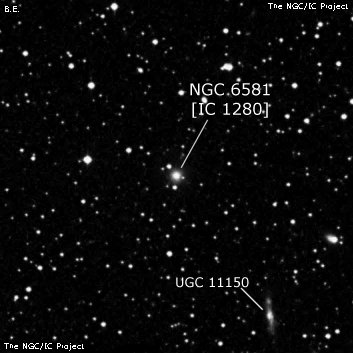
eg 6581:  0'.6 x 0'.3:  Vis. 14.9; SB 12.9:  Of the three galaxies, UGC 11156 was the easiest to spot.
eg U 11156:  1' x 1':  Vis. and SB 13.3:         It was noted at 150x, and also observed at 187x and
eg U 11155:  1' x 0'.8:  Vis. 13.9; SB 13.6:    200x.  It is pretty large and round.  UGC  11155 is much fainter, though somewhat similar, perhaps a bit oval.  It was viewed at 150x and 187x with averted vision.  6581 is a bit of a mystery.  Uranometria is the only altals to plot it where it is, using the above specs.  Others place it about 20' north, between UGC 11050 and an 8 mag. star to the north following.  I did see this version, which was faint but with a brighter center.  AT 187x and 200x it was oval.  The first 6581 seems to be round, about 0'.4 x 0'.4, and brighter than the north one.  The north one is referred to as I. 1280.  Uranometria is the only place that makes these 2 separate objects.  Other sites duplicate them, not mentioning the south one.
http://www.ngcicproject.org

eg 6586:  0'.9 x 0'.5:  Vis. 13.7; SB 12.7:  Spotted at 125x, near a 'bright' star.  150x shows a small but pretty bright cigar shape.  It was seen well at 187x and 200x, though it was best with averted vision, epsecially due to the nearby star.
http://www.ngcicproject.org

eg 6587:  1'.3 x 1'.1:  Vis. 12.9; SB 13.2.  Spotted at 100x, it was round with a bright stellar core.  150x showed a fuzzy object, similar to a small comet.  At 200x it was still bright, and near a 'bright' star, north.
http://www.ngcicproject.org

eg 6593:  0'.9 x 0'.7:  Vis. 14.3; SB 13.7:  I was able to confirm sightings at 187x, 200x, and 250x.  It was oval, faint, and in a line with two very faint stars, north.  Finding this galaxy without aid was confirmation of exceptional transparency tonight (August 12th/15).  

eg 6599:  1'.3 x 1'.2:  Vis. 12.6; SB 13:  First seen at 125x, it is situated in a small star group.  2 faint stars and 1 very faint star lie near it.  It was also viewed at 150x, 187x, 200x, and 250x.  Even so it remained round, small, but pretty bright.
http://www.ngcicproject.org
eg 6602:  0'.9 x 0'.7:  Vis. 13.3; SB 13.1:  Following a line from a south preceding mag. 9 star thru eg 6599 and extending it the same distance north following, I was able to locate this galaxy at 150x.  It is faint, slightly oval, and has a faint star preceding it.  Views are still decent at 187x and 200x, though best with averted vision.
http://www.ngcicproject.org

eg 6616:  1'.4 x 0'.6:  Vis. 13.8; SB 13.5:  Confirmed at 187x, it resembled a fuzzy, dim star.  It was seen better at 200x, and was even quite oval at 250x.  The galaxy lies very near a bright star, south preceding.
http://www.ngcicproject.org

UGC 11197:  1'.1 x 1'.1:  Vis. 13.3; SB 13.4:  Lying a degree south of eg 6616 and a bit following, it was spotted at 100x.  It is seem best with averted vision because of an 8.5 mag. star south preceding.  The galaxy is round, with a pretty bright middle and a gainter outer envelope.  Good views were had at 187x.

eg 6619:  1'.2 x 1'.1:  Vis.  13; SB 13.3:  This galaxy, along with 6623, were the brightest ones of the night (Aug. 12th/15).  Randy G. observed with me.  Both galaxies can be seen at moderate powers.  19 was easily spooted at 100x, making a rough triangle with 2 close stars of near equal mag.  The galaxy appeared round, with a very bright core.  A 14 mag. star is conspicous at 200x, and another even closer to the envelope.  250x gave decent views.
http://www.ngcicproject.org

eg 6623:  1'.3 x 1'.2:  Vis. 13; SB 13.5:  A near twin to nearby 6619!  They can be viewed together at 100x, 125x, and 150x.  It shows a stellar core.  Very good views were had up to 250x, where several faint stars were observed near the outer envelope (one of these may have been the MCG galaxy!).
http://www.ngcicproject.org

eg 6628:  1'.9 x 1'.3:  Vis. 12.9; SB 13.8:  Spotted at 100x, it was elongated.  It sits immediately preceding a mag. 9 star.  Weird, but that is all I said about it.
http://www.ngcicproject.org

eg 6632:  3' x 1'.4:  Vis. 12.1; SB 13.5:  A remarkable object, and observed from 60x through 250x.  At 60x and 100x, views were best with averted vision.  It was large, dim, and oval.  At 150x it was difficult to block glare from a nearby 5.5 mag. star, south.  At 187x, 200x, and 250x it was decent, and nearly involved with a faint star, preceding.
http://www.ngcicproject.org

eg 6641:  0'.9 x 0'.7:  Vis. 13.4; SB 12.7:  Spotted at 100x and confirmed at 150x, ti was oval.  187x gives a pretty good view.  The galaxy is pretty large, but sits near a relatively bright star.  It was fading at 200x, but quite oval.
http://www.ngcicproject.org

eg 6658:  1'.7 x 0'.4:  Vis. 12.9; SB 12.4:  Glimpsed with averted vision at 100x, the galaxy was a long, thin, very faint slash.  This is not an object that compares well to its listed mag.  It was seen at 150x and 187x, and was okay to view at 200x with averted vision.  It appears to be involved with a faint star, or perhaps had a bright core, or both.
http://www.ngcicproject.org

eg 6661:  1'.7 x 1'.1:  Vis. 12.1; SB 12.6:  Noted at 100x, it was very bright. 150x showed the oval shape.  It sits in a pretty bright starfield, making initial discovery a bit tricky.  At 187x it is large and medium bright.  Though fading at 200x, it shows a stellar core.
http://www.ngcicproject.org

eg 6669:  0'.9 x 0'.9:  Vis. 15.1; SB 14.7:  One of those mystery objects.  The image below identifies a tight and very faint asterism, which could be what Herschel actually saw.  However, at the location on Uranometria is a faint galaxy.  See the Deep Sky Objects Browser for what I saw.  A round haze, involved with a faint star, is nearly impossible to see, even if the exact location is known.  Seen with averted vision at 200x and 250x.  It is the 4th star in a faint line curving south (not the 5th star, which looks hazy but is actually a close triple star).  I sincerely doubt that Herschel saw the galaxy--the close triple seems more likely.
http://www.ngcicproject.org

eg 6674:  4' x 2'2:  Vis. 12.2; SB 14.4:  Not even visible to me on the last evening, tonight it was quite apparent and lovely!  Spotted at 60x, it was faint, ghostly, and large.  100x shows it as a nice object, though in this range it is a challenge to view it with the 8" stop in place.  A faint star is preceding.  The galaxy is very elongated, with a brighter central area, though the outer elongated envelope is clearly visible.  187x and 200x show 3 stars possibly involved.  It fades overall at 200x, but the central oval is still bright.
http://www.ngcicproject.org

eg 6680:  0'.7 x 0'.4:  Vis. 14.6; SB 13.1:  Spotted at 150x, and also viewed at 200x and 250x.  A small, elongated hazy smudge was noted immediately south of a 10.5 mag. (?) star.
http://www.ngcicproject.org

eg 6697:  1'.2 x 1'.1:  Vis. 12.7; SB 12.9:  Spotted easily at 100x, it was round.  150x reveals a very bright core.  187x and 200x appear to show a star imbedded in the following end.  At 200x and 250x the galaxy is still bright and a good object for a 12" scope.
http://www.ngcicproject.org

UGC 11346:  1' x 0'.7:  Vis. 13.7; SB 13.2:  Lying south preceding 6697, this galaxy i very small and very faint, seen at 200x with averted vision, where it barely shows.  It was slightly improved at 250x, where it finally appeared to be oval and a bit larger.

Mapman Mike


Monday, 7 August 2017

#110 Hercules NGC Project Part 4: Uranometria Chart 68

This is a busy chart, so I will do it in 2 sections, both seen below.

Chart 68, Right Side 

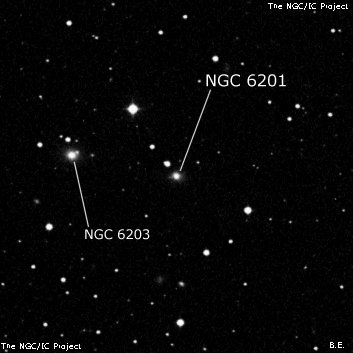
eg 6201:  0'.3 x 0'.2:  Vis. 14.6; SB 11.4:  Using a hand-drawn detailed star chart (I use Deep Sky
eg 6203:  0'.6 x 0'.6:  Vis. 14.4; SB 13.1:  Objects Browser, an excellent on-line resource), I eventually found the correct area to search.  Both galaxies can be glimpsed at 187x.  6903 is larger and easier to see, though it appears stellar at times.  6201 is stellar at 187x.  250x, 272x, and 378x give good glimpses of 6903, using averted vision.  In this range even 6201 improves somewhat.  It is very small with averted vision.  Both galaxies are close to pn 6210.  A 16" would be a much better search tool.


http://www.ngcicproject.org


pn 6210:  21"; Vis. mag. 8.8; Cent. * mag. 12.6:  Spotted at 60x, it is an incredibly bright object,and fun to observe.  A filter is not needed.  The central star is not easy to distinguish because of the overall brightness.  I was able to observe the nebula up to 500x, one of the very times I use this high a magnification.  It appears oval and pretty large at 375x and 500x.  There seems to be fainter edges.  The object is almost football-shaped.  It was seen well back in the old 8" days, and no doubt can be viewed with a 6".
http://www.ngcicproject.org

eg 6228:  0'.9 x 0'.5:  Vis. 14; SB 13.3:  I needed another diagram for this faint object.  Observed at 136x (barely), it is a very faint cigar at 187x and 250x.  It is pretty small.
http://www.ngcicproject.org

eg 6233:  1'.4 x 1'.1:  Vis. 13.3; SB 13.5:  Suspected at 100x, the galaxy sighting was confirmed at 136x.  At 187x a brighter center is noted, with fainter haze surrounding.  At 250x it is ghostly, large, and very oval.  It now shows a stellar core.  A 9.5 mag. star is just south following, making location fairly easy.
 http://www.ngcicproject.org

eg 6243:  1'.1 x 0'.4:  Vis. 14.1; SB 13.1:  Observed at 136x, 187x, and 250x.  I saw a pretty large but very faint very elongated oval.  The middle area is much brighter.  Seen best with averted vision.
 http://www.ngcicproject.org

eg I. 4630:  0'.8 x 0'.5:  Vis. 13.6; SB 12.5:  This one seemed within reach.  It was suspected at 136x and confrimed at 187x.  It has a stellar core, is very small, and very faint.  At 250x it formed a dim cigar shape.  At 272x a bright core is visible, with a much fainter surrounding envelope.  Averted vision shows it best.  Tricky to see at first.

eg 6267:  1'.3 x 1':  Vis. 13.1; SB 13.3:  Spotted at 100x, as the sky kept getting better and better tonight (July 26th/16).  At 136x the galaxy is pretty large, oval, and showing a bright center.  It is easy to spot in this range.  At 187x and 200x it is large and pretty faint.  It appears evenly lit.
 http://www.ngcicproject.org

eg 6276:  0'.4 x 0'.3:  Vis. 14.6; SB 12.2:  78 was seen at 100x, being small but very bright.  Up to
eg 6278:  2' x 1'.2:  Vis. 12.4; SB 13.2:  272x shows a very bright center, oval.  The extensions are not obvious; it just seems large and oval.  The galaxy appears significantly smaller than its given dimensions.  76 was spotted at 136x.  It is not difficult to identify, but too small to notice anything much.

eg I. 1236:  1' x 0'.8:  Vis. 13.6; SB 13.2:  Glimpsed at 100x, it is a bit easier to identify at 136x.  Seen well at 187x, it is slightly oval and pretty big.  It sits between 2 faint stars, though not directly between.  The galaxy fades at 250x, with a bright star nearby masking it (mag.7.7).

Next, a group of 8 galaxies, all located in the same half degree field.  Look between +27 and +28 degrees, and between 16 hours 56 minutes R.A. and 17 hours.

eg 6261:  1'.4 x 0'.5:  Vis. 14; SB 13.4:  Spotted at 136x.  It becomes a faint but decent slash at 187x.  Views are still good at 250x.  The galaxy is pretty wide and fairly long.  
 http://www.ngcicproject.org

eg 6263:  0'.0 x 0'.9:  Vis. 13.7; SB 13.4: Spotted at 100x, north of a faint star, and between it and a 9.3 mag. star.  The galaxy is very close to the fainter star.  Good views can be had at 136x and 187x, best with averted vision.  There is a bright stellar core.  The object is fading at 250x.
 http://www.ngcicproject.org

eg 6264:  0'.7 x 0'.5:  Vis. 14.5; SB 13.2:  65 can be spotted at 136x, preceding 6269 (below).  It is
eg 6265:  0'.9 x 0'.6:  Vis. 14.2; SB 13.4:  pretty large, very oval, and pretty bright with averted vision.  Good views were had at 187x and 250x.  6264 is much smaller and much fainter, sighted at 187x, 200x, and 250x.  It can be found north following a faint star, and only with averted vision.  It is very small and very faint.
 http://www.ngcicproject.org

eg 6269:  2' x 1'.6:  Vis. 12.2; SB 13.5:  This big, fairly bright galaxy sits at the heart of a cluster of 8 NGC galaxies.  Most are very faint.  69 was spotted at 60x.  At 100x it showed a big oval shape, pretty bright, especially the center.  136x shows a stellar core.  187x shows at least 2 very faint stars south, and another north.  200x and 250x give good views, especially of the large, central area, brighter than the outskirts.  The best object of this tight group of 8 galaxies.
 http://www.ngcicproject.org

eg 6270:  0'.5 x 0'.5:  Vis. 13.3; SB 11.9:  Don't believe the hype!  This is the most difficult of the group!  Think at least 2 mag. fainter than given.  It is very, very small and very, very faint, a threshold object at 187x, 200x, and 250x.
  http://www.ngcicproject.org

eg 6271:   0'.6 x 0'.6:  Vis. 14.1; SB 12.8:  
eg 6272:   0'.5 x 0'.2:  Vis.  14.5; SB 11.9:  Both of these galaxies were easier than 6270.  71 was not difficult using averted vision.  72 is very small and very faint.  It can be glimpsed using 187x and averted vision.  72 is not for the faint of heart.  Both are seen at 250x.
 http://www.ngcicproject.org
                                                                                                                                           

eg 6308:  1'.2 x 1'.1:  Vis. 13.4; SB 13.5:  Observed at 136x and 187x, preceding a field of faint stars.  The galaxy is large, pretty bright, and round.  It is very close to the pair 6314/15, which are just south following.
  http://www.ngcicproject.org

eg 6314:  1'.4 x 0'.7:  Vis. 13; SB 12.8:  14 is pretty large, bright, and elongated.  It was spotted at
eg 6315:  0'.8 x 0'.6:  Vis. 13.2; SB 12.3:  136x.  It just precedes a double star, a close pair and pretty faint.  6215 is small and faint, located between 6214 and a bright star.  187x shows both objects well.
  http://www.ngcicproject.org

eg 6321:  1'.1 x 1':  Vis.  and SB 13.4:  Spotted at 136x, it is small, round, and faint.  At 187x it is best with averted vision, being close to 2 stars.  It is round and faint.  Views are best at 200x.  It fades at 250x.  A bit tricky to locate.


NOTE:  For eg 6274, 6274A, 6282, 6330, 6364, 6486, 6487, UGC  11017, see blog entry for Chart 50 (forthcoming).


Chart 68, Left Side

eg I. 1256:  1'.6 x 1':  Vis. 13.2; SB 13.7:  Located at 136x, the galaxy is large, oval, and faint.  Best view is at 187x, as it is fading at 250x.  It is pretty large, though, and lies in a bright star field.

eg 6371:  0'.8 x 0'.3:  Vis. 14.3; SB 12.6:  6372 was spotted at 100x, and the much smaller and
eg 6372:  1'.7 x 1'.1:  Vis. 12.9; SB 13.4:  fainter 6371 at 136x.  72 is bright, oval, and quite easy to see, especially with averted vision.  71 was seen best at 187x, and only with averted vision.  It is small, oval, and very faint.
http://www.ngcicproject.org

eg 6408:  1'.6 x 1'.4:  Vis. 12.7; SB 13.4:  Spotted at 100x, it was pretty large, round, and very faint.  150x shows it moderately better, with a brighter center now seen.  187x gives the optimum view, showing it to be big and round, but not very bright.
http://www.ngcicproject.org

eg 6417:  1'.4 x 1'.2:  Vis. 13.1; SB 13.5:  Suspected at 100x ,the galaxy is located easily at 136x, despite its proximity to a mag. 7 star.  It is round, reasonably bright, and relatively close to the star.  It becomes more ghostly at 187x, and quite large, especially if the offending star is kept out of the field.  It appears to be evenly lit.
http://www.ngcicproject.org

eg 6427:  1'.6 x 0'.6:  Vis. 13.3; SB 13.1:  Spotted at 136x, it was round, bright, and showing a stellar core.  At 187x a few faint stars are seen very near.  Views are still good at 250x, though I am only seeing the central globe.
http://www.ngcicproject.org

eg 6429:  1'.9 x 0'.6:  Vis. and SB 13.1:  Spotted easily at 136x, it is bright and very oval.  At 187x a very faint star lies in or close to the haze.  250x gives a good view.  272x shows a bright stellar core, and good views overall.
http://www.ngcicproject.org

eg 6430:  1'.7 x 0'.5:  Vis. 13.5; SB 13.2:  Uranometria does not list the NGC number, instead calling this UGC 10966.  Other sources informed me that this is, indeed, eg 6430.  Spotted at 187x, it was very elliptical and very faint.  It is located just north of a bright star (mag. 9.5) and south of a faint asterism.  My telescope computer calls 6430 an asterism.  Interesting stuff!
http://www.ngcicproject.org

eg 6442:  1'.9 x 1'.5:  Vis. 12.6; SB 13.7:  Spotted at 100x, it appeared oval in shape.  At 150x it is pretty bright, though not very large.  187x and 200x occasionally show it as a much bigger object.  It can be found just preceding a tiny, faint triangle of stars.
http://www.ngcicproject.org

eg 6452:  0'.5 x 0'.5:  Vis. 14.4; SB 12.7:  Glimpsed at 150x and 187x, it is elusive, small, dim, and round.  It is just preceding a faint group of 3 stars.  At times the galaxy appears stellar.
http://www.ngcicproject.org

eg 6458:  1'.3 x 0'.9:  Vis. and SB 13.4:  Both galaxies can be seen at 100x.  At 150x 58 seems a bit
eg 6460:  1'.9 x 1'.1:  Vis.  13.1; SB 13.8:   brighter, and though appearing pretty large, 60 is still showing well.  It is now quite elongated, with a slightly brighter middle.
http://www.ngcicproject.org

eg 6467:  2'.6 x 1'.7:  Vis. 12.6; SB 14.1:  Spotted at 100x, it was large, oval , and very faint.  At 150x the full extent of the galaxy is trying to come through, causing flaring in all directions with averted vision.  Seen best at 187x, the galaxy is involved with several very faint foreground stars.  A possible stellar core was noted.  It sits between two relatively bright stars, the south one being double.
http://www.ngcicproject.org

eg 6482:  2' x 1'.7:  Vis. 11.4; SB 12.8:  At 60x and 100x, the galaxy looks like a very bright planetary nebula.  150x shows some very faint haze with averted vision, but the center is extremely bright.  187x, 200x, and 250x show a large, round, very faint haze surrounding an almost blindingly bright central core.  A bright galaxy but otherwise unexciting.

eg 6484:  1'.9 x 1'.9:  Vis. 12.3; SB 13.6:  Spotted at 100x and observed well at 136x.  It is very large, round, and pretty bright.  Good views were had at 187x, 250x, and 272x.  It is very large, round, pretty bright, and has a stellar core.  Also seen back in the day with the Edmund 8".
http://www.ngcicproject.org

eg I. 1269:  1'.7 x 1'.3:  Vis.  12.8; SB 13.5:  Located at 100x, it was large and oval, and sitting within a bright triangle of stars, approx. mag. 11.5.  Though faint overall at higher powers, the central area stays pretty bright up to 200x.

eg 6490:  1.'1 x 0'.9:  Vis. 13.5; SB 13.3:  This turned out to be a lovely pair of galaxies, and I
eg 6495:  2'.1 x 1'.8:  Vis. 12.2; SB 13.5:  spent considerable time here.  The pair are separated by the base line of a faint triangle of stars, with the north preceding one being double.  Both galaxies were seen at 100x, but it was at 150x that the size difference really comes through.  95 appears to be a tiny bit brighter overall than 90, but not by much.  They remain in the same field of view at 187x and 200x.  Recommended with a 12".
http://www.ngcicproject.org

eg 6500:  2.'2 x 1'.6:  Vis. 12.2; SB 13.4:  Despite a 7.4 magnitude star in the field, both galaxies
eg 6501:  2' x 1'.8:  Vis. 12; SB 13.3:   were seen at 100x, where they already appear to be very bright and quite large.  150x shows them as remarkably similar in appearance, and still really bright.  At 187x and 200x things remain very bright, and stellar cores are noted.  6500 now appears oval.  200x and 250x show both objects well, and they make another fine pair, worth seeking out with a 12".  I applied 300x, but it did not improve things over 250x.  Now, if it weren't for that 7.4 mag. star...
http://www.ngcicproject.org

eg 6513:  1'.2 x 0'.8:  Vis. 13.3; SB 13.1:  At first I could not find it.  I looked long and hard, before finally giving up.  I came back later in the night, then realized I had been looking at the wrong two guide stars.  As soon as I found the correct spot, there it was.  The galaxy was pretty big and bright at 136x.  It was very good to view at 187x, but fading somewhat at 250x.  At high power it is very oval, and still fair to view with averted vision.
http://www.ngcicproject.org

eg 6518:  0'.4 x 0'.4:  Vis. 13.9; SB 11.8:  This was an easy one!  It was located at 136x.  It lies south of a fairly bright star, and reminded me of a medium-sized planetary nebula.  At 187x views were good, with the galaxy being bright and very round.  At 250x a stellar core is noted, with a possible faint star on the preceding lip of the envelope.  The galaxy remains bright with averted vision.
http://www.ngcicproject.org

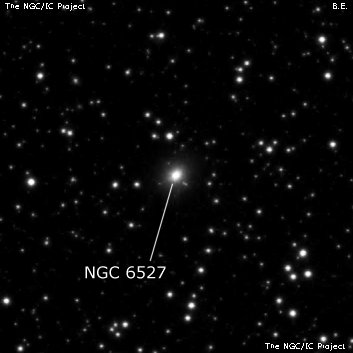
eg 6527:  1'.4 x 1':  Vis. 13.4; SB 13.6:  Located at 100x, south of a mag. 11 or mag. 12 star, just following a tiny, dim mini-cluster of stars.  150x shows a bright center.  Though pretty faint at 187x and 200x, the oval shape is noted, along with a brighter middle.
http://www.ngcicproject.org 

I am now five days away from the next two-week observing period.  I should have time to get Chart 67 up before then.  the rest will have to wait until the August session is completed.  By then, I should also be able to report on the deep sky objects of Scutum.  Until then, clear skies!
Mapman Mike

Thursday, 27 July 2017

#109 Hercules NGC Project Part 3: Uranometria Chart 69

The left side of Chart 69 includes many galaxies in Hercules.  Also present is the north half of close-up Chart A-9.  That chart will have its own blog entry soon, and so those galaxies will be omitted from this entry.

eg 6032:  1'.6 x 0'.7:  Vis. 13.5; SB 13.4:  The galaxy is large, but faint and very elongated.  It has a wide middle, and was located at 136x.  It was best seen at 187x with averted vision.
http://www.ngcicproject.org

eg 6035:  0'.9 x 0'.9:  Vis. 13.5; SB 13.1:  Round and pretty large, it is considerably brighter than 6032.  Located north of a triangle of bright stars.  32 and 35 are both fading at 200x, though 35 is easier to see.  Even so, it is a pretty faint object. 
http://www.ngcicproject.org

eg 6052:  0'.9 x 0'.7:  Vis. 13; SB 12:  Previously viewed with the 8".  Located tonight at 60x, it was bright, round, and reminded me of a planetary nebula.  It is very bright at 100x, and still round.  At 136x it begins to look oval.  It is located between two stars (midway), and there is also a faint star preceding.  At 187x and 250x the galaxy is very bright, oval, but quite small.
http://www.ngcicproject.org

eg 6060:  2'.1 x 1'.1:  Vis. 13.1; SB 13.8:  An impressive galaxy--yay!  Spotted easily at 60x, it is already big and very elongated at 100x.  Very good views are had at 136x.  At 187x and 200x it is very large and still pretty bright.  Recommended viewing.
http://www.ngcicproject.org

eg 6062:  1'.2 x 0'.9:  Vis., SB 13.6:  62 is flaring oval at 136x.  It seems pretty bright and pretty
eg 6062B: 0'.4 x 0'.4:  Vis. 15.3; SB 13.2:  large.  The center is brighter than the edges.  At 187x views are pretty good.  62B can be (barely) glimpsed at this range, south of the main galaxy and separate from it.  It has a stellar core, is very faint, small and round.
http://www.ngcicproject.org 

eg 6075:  0'.9 x 0'.7:  Vis. 13.9; SB 13.5:  Spotted at 100x, it was small but pretty bright ,especially when compared to 6148.  At 136x I noticed a stellar core.  There are good views at 187x.  At 200x it appears oval, and it is fading at 250x.
http://www.ngcicproject.org

eg 6084:  1' x 0'.6:  Vis. 13.9; SB 13.2:  This one is tricky to see due to its proximity to a mag. 10 star.  I searched everywhere else first, then finally spotted it just north following the bright star.  A very faint oval was glimpsed with averted vision at 187x and 250x.
http://www.ngcicproject.org

eg 6098:  1' x 0'.7:  Vis. 13.3; SB 13:  Seen at 136x as one long oval object.  It is rather faint.  At 
eg 6099:  0'.9 x 0'.9:  Vis. 13.4: SB 13:  187x and 250x they become a very tight pair, likely interacting.  Both galaxies have stellar cores, and are pretty small and faint.  One is oval and the other is round.


http://www.ngcicproject.org

eg 6148:  0'.5 x 0'.3:  Vis. 16.1; SB 13.8:  This might be the most challenging NGC object to date.  Even using a very detailed pinpoint hand-drawn map, this galaxy is extremely difficult and elusive.  I had near-perfect transparency to aid me, finally catching glimpses of a very small, very dim oval immediately following the middle star of a faint trio.  It was glimpsed at 250x, 272x, and 375x.  NB:  Just as an aside, I was able to glimpse the central star in M 57 tonight, at 272x.  It was the best sighting yet with the 12"!
http://www.ngcicproject.org

eg 6149:  1'.1 x 0'.8:  Vis., SB 13.2:  Noted at 100x, it is bright but small.  At 136x it is small, oval, and very bright.  At 187x and 250x it is oval, has a very bright middle and has a fainter outer envelope.  It is a fairly elongated oval.
http://www.ngcicproject.org

eg 6168:  1'.4 x 0'.3:  Vis. 14.2; SB 13.1:  This galaxy appears as a long, very elusive slash.  It was spotted at 250x first, then viewed at 272x.  As full darkness was finally reached (June 27th/16) it was also seen at 187x, and then even at 136x.  A bright star is south (10.6 mag.).  Two very faint stars follow it.
http://www.ngcicproject.org

eg 6181:  2'.5 x  1'.1:  Vis. 11.9; SB 12.5:  Viewed previously with the 8", and sketched at that time.  Tonight it was spotted at 60x, and viewed up to 272x.  It is large, very bright, and very elongated.  The central area seemed brighter, as if a bar ran through the length of the galaxy.  The edges are noticeably fainter.  Good views were had at 250x.  A rather impressive galaxy!  


http://www.ngcicproject.org
 
eg 6186:  1'.7 x 1'.3:  Vis. 12.9; SB 13.6:  Spotted at 100x, it is large, pretty bright, and oval.  136x shows a stellar core.  A very faint star is south.  It was also viewed at 250x, 272x, and 375x.  It is very oval, bright, and pretty large.  Fortunately it is far enough away from Beta to be seen well.
Mapman Mike