Showing posts with label Edmund Astroscan. Show all posts

Tuesday, 9 April 2024

#149: Total Solar Eclipse 2024

It was a very successful trip to Ohio to view totality.  We were able to experience 3' 40" of totality, an experience never to be forgotten. We braved horrendous traffic both ways, not getting home until 11:20 pm.  We left home at 9:15 am that morning.  We aimed for a small town (Tiffin), but on arrival it seemed to be nothing but a circus event, with preachers bellowing, people getting married, loud music blasting from a live band, and general overcrowding.  So we returned north 10 miles to Wolf Creek Park, and found our paradise location for this important day.  First some facts.  The park was a medium sized picnic grounds, with a large open grassy area.  We had a large picnic shelter for shade, but set up our Edmund Astroscan scope (4 1/4" mirror) in the open.  We have a solar filter that fits over it at the front.  Our latitude was 41 17' N, and the longitude was 83 10' west.  We used three eyepieces giving 16x, 18x, and 25x.

Our observing site at Wolf Creek Park, Ohio.  Deb checks out sunspots.  Our grey VW Golf in behind Deb.  The scope is an old but trusty Astroscan from Edmund Scientific.
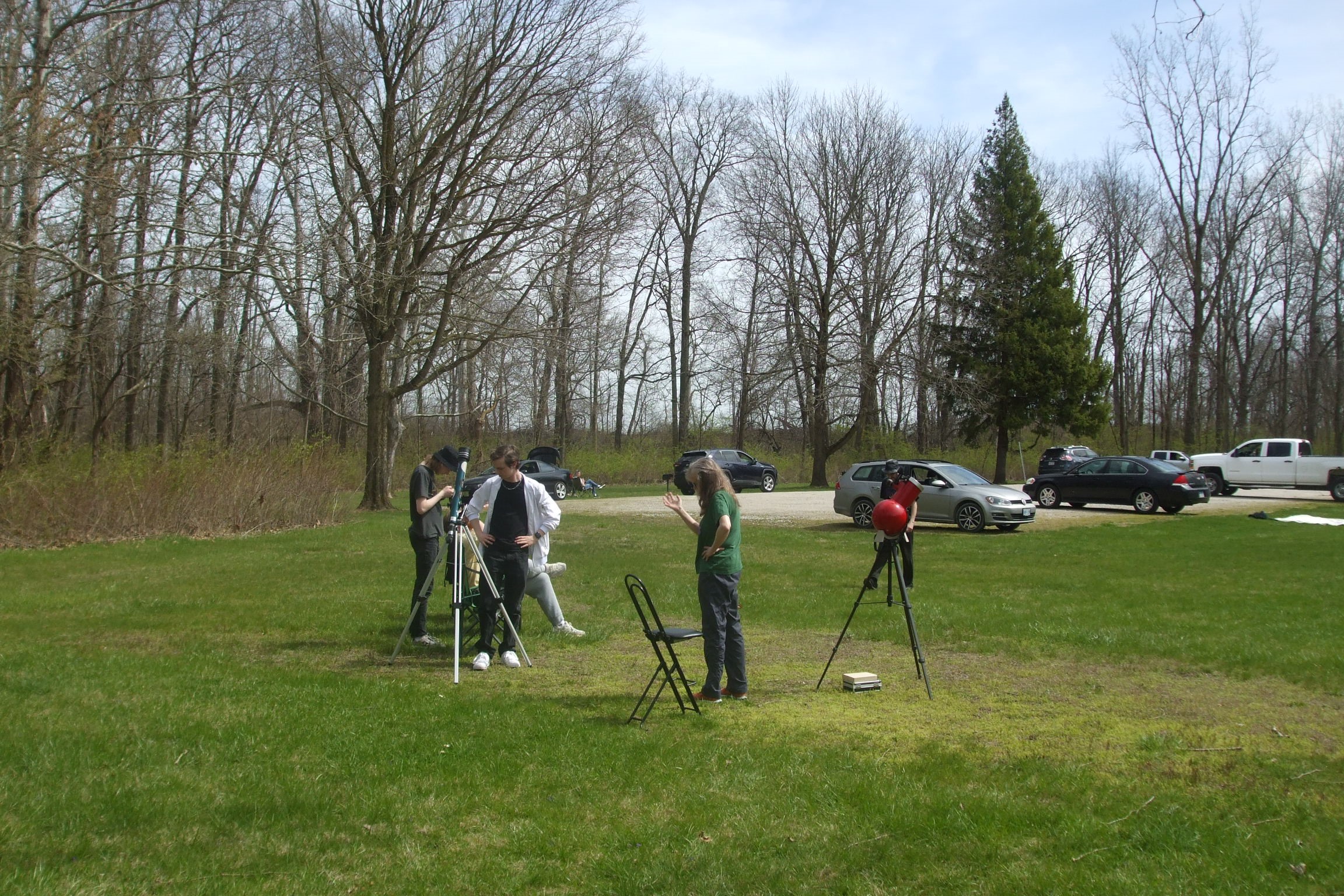
 
Another view of the scope and our viewing area.  We brought a picnic lunch and snacks.
 
We were joined by some young viewing enthusiasts.  Hayden (white jacket) had travelled from North Carolina to view the eclipse.  He is a photographer and physics student at UNCG, mostly interested in astrophysics.

Skies were mainly sunny with high wispy clouds.  It became a bit hazier during totality.  The temperature at the start was 71 F.  It dropped to 63 F during totality.  There were three sunspot groups today.  We labelled a large double one "AA".  A smaller though still large one was called "B", while a smaller group of four tiny spots we called "C".  Eclipse start time was 13:56:30  Totality began at 15:11:16, and lasted for 3' 40".  Sunspot group "AA" was eclipsed at 14:38:43, taking 1' 50" to completely vanish.  A big group!  We did not stay long after totality was complete.

The experience of viewing a total eclipse was completely mind-boggling.  The plentiful birdsong from the woods ceased suddenly, the afternoon breeze vanished, darkness was nearly total, and  very sudden.  For 3' 40" we witnessed the bright corona shooting out in all directions from behind the moon, as well as a very large solar flare in the south end.  Special glasses are not needed during totality, and would only show darkness.  We saw a twilight sky on the southeast and northwest horizons.  Light bark on tall poplar trees stood out as if luminous under black light.  We could discern light and shadow on the ground right up to the final seconds.  Then, suddenly, darkness arrived, the most mysterious kind of dim twilight one could ever imagine.  The 'diamond ring' was visible in the telescope just before totality, lasting perhaps 1-2 seconds, accompanied by two 'beads' of light.  Others saw the ring with their special glasses.  Then came the spellbinding sight of the very active solar corona, accompanied by a sizable and bright flare at the south end.  There was darkness, stillness, and a  general quiet that became almost overwhelming.  All of this was seen and experienced with all normal senses.  The telescope showed nothing until the sun reemerged.  Venus and Jupiter shone brightly through the thin hazy clouds, Venus ahead of the sun and Jupiter behind it.  But even though we were near the centre, and enjoyed a fairly long eclipse time, it was over far too quickly.  It seemed as if one minute had passed, instead of almost four.

We were accompanied at our site by three young friends, who remained with us during most of the event, including totality.  They were happy to use the Astroscan, and we were happy that one of them, Hayden, was a photographer and physics student.  All of the shots of the sun on this page were taken by Hayden Atchison.  Through the telescope eyepiece he used his iPhone; for totality shots he used his main camera.  I took the daylight ground shots.

There is no doubt that the eclipse was also a hugely spiritual experience.  We have had many such experiences in our lifetime, but this one was greatly intensified because of its brevity.  Imagine taking the time to listen to all of the Mahler symphonies.  Now condense that experience down to 3 minutes and 40 seconds.  Imagine carefully studying all of the paintings by Pieter Bruegel the Elder, and condensing all those special moments of revelation and delight into 3' 40".  Our climb to the summit of Wheeler Peak in New Mexico took an entire day, but still energizes our spirits years later.  Again, condense that emotional, physical, and spiritual event into 3' 40".  Then you might have something of the effect (and affect) of viewing a total eclipse in the woodlands of Ohio.  It also gave us a tiny sense of just what the Sun actually is--a vast nuclear furnace of a scale that goes well beyond our comprehension.

This event happens to be my 999th logged astronomical event!  I began by studying the moon with binoculars in November 1968, and am still an active amateur astronomer.  It is also the last entry in my 13th volume of detailed notes recording my observations of the past 56 years.  A lucky volume, indeed.

Here are a few of Hayden's photos.

 
Shot through the eyepiece with an iPhone. The two largest sunspot groups show up well here.
 
The 'B' sunspot group is about to be eclipsed.

Approaching totality.  The sun's horns were actually very sharply focused in the telescope.
 
Many people saw a 99% eclipse only, including Toronto.  Even when only 1% of the sun is exposed, it throws the same amount of light as 400 full moons!  We could see shadows right up until totality.  While a 99% eclipse is very impressive in its own way, it is more than 99% less than viewing a total one.
 
A beautiful shot of totality by Hayden!  A jet trail comes between the eclipse and Venus.  The solar flare can be seen at the south end.  It was very prominent visually.
 
Totality 2024.  All images of the sun, above, were taken by Hayden Atchison, a physics student at UNCG.
 
If you were in the path of totality this year and managed to see the eclipse, drop me a line with your impressions.  I would love to hear about them.

Mapman Mike 

Friday, 21 May 2021

#132: Messier 24 Star Cloud


This month I am combining my two articles, At The Eyepiece, and Messier of The Month into one. Also known as the Sagittarius Star Cloud, M 24 has a somewhat confusing history due to a wrong R.A. assigned to it by Barnard. It wasn’t until 2001 that the mistake became well known, and Messier’s original discovery could be acknowledged (see the longer explanation at cseligman.com, under the IC 4715). There is only one other Messier object with an IC designation, that being M 25/IC 4725. Easily seen with the naked eye, M 24 is very large, extremely star-rich, and beautiful in binoculars and a joy in a rich field telescope, such as the Edmund Astroscan. While much of Sagittarius provides rich sweeping at low power, there is no denying the intensity of M 24.

While it appears stunning with any sort of visual aid, I spent over an hour here one September night in 2014 with a 12” Dob, exploring every nook and cranny of this colourful, star-filled area. Within the cloud are three other small open clusters, as well as a planetary nebula. So if you have some time to spend one fine summer or early autumn evening, M 24 is a recommended stop. The cloud’s size is given as 120’ of arc, so I began exploring with my lowest possible magnification, which is 43x. Oc 6603 is conspicuous right away. Immediately south of the cluster are 6 bright stars, arrow shaped. These stars appear to be involved with the richest and most splendid area, and seem to be at the heart of the cloud. The sweeping continues to be exceptional if moving south preceding to variable star V4387 (see map). A bright yellow star, V4387 leads south to another beautiful area of thousands of stars. Moving back to the original arrowhead, the star just south of oc 6603 is a deep orange. South following is a bright double star, yellow and blue, one of many doubles within the cloud. There is so much more to discover about the cloud itself, but I will move on to some of the other named points of interest.


Oc 6603 (Size 4’; Visual Mag. 11; brightest star mag. 14; 100 stars) is hazy, bright, and not too small at 43x. It looks so much like a comet that no wonder some people still mistake this cluster for M 24 itself. Even at 43x it begins to resolve. We were also able to resolve some of it in Deb’s 6” reflector at 125x. At 60x and 12” the cluster is still bright, and still in the beginning stages of resolving. At 100x there is some resolution all across the cluster, similar to that of a globular cluster. A bright line of unresolved haze runs through the middle, NE to SW. 125X gives decent resolution, with the central hazy bar narrowing. The cluster is finally fully resolved at 250x, including the bar, now seen as a line of tiny stars. There are dark patches on either side of the line, as well as many tiny stars. This object is a real beauty in a 12” scope!

Collinder 469 is a compact cluster ( Size 2.6’; Visual mag. 9.1; 15 stars) preceding oc 6603 by 2’ of R.A., and just a tiny bit north. I located it at 60x, noting several bright stars in a tight V-shape, with background haze. At 100x it is very compact, with few faint stars resolving. At 200x 15 stars can be counted, several being very faint.

Oc Mrk 38 (2’) shows three bright stars at 60x, one of them being yellow and quite bright. At 200x 10 stars are seen very close to the bright three, with a few others close by.

Planetary nebula 6567 lies just south preceding Mrk 38. At a minuscule size of only 12” of arc, the object appears virtually stellar at 250x. A tiny bit of fuzz can be discerned around it, being a grayish-blue colour. It is bright, at mag. 11, and I have seen it with an 8”. The central star is mag. 14.3, though it is washed out by the brightness of the haze.

While sometimes passed over for the wondrous nebulae and clusters in Sagittarius, M 24 is worth spending time exploring.   I haven’t visited yet with Space Eye, my 2” refractor, but it’s on the list for summer.  Clear skies.

Mapman Mike