Showing posts with label Messier 15. Show all posts

Monday, 25 October 2021

#133: Day Trips and Night Trips, and Messier 15

At The Eyepiece, by Mike Ethier

Many of us enjoy day trips, being easy-to-arrange travel getting us there and back in the same day. Nearby Ontario places like Point Pelee, the city of London, Sarnia, and smaller centers and parks in between, offer good options for a quick and easy mini-vacation. When the US border is open, Detroit offers a virtual Milky Way of day trip options, from concerts, sporting events, and art galleries, to shopping, dining, and whatever else one might wish to do in a large city. Ann Arbor, Toledo, and many interesting suburbs offer the day visitor many more options. Windsor and Essex County citizens are fortunate to have so much on offer so near to home.

Now imagine if our local environment changed gradually over the year. Slowly, Chicago emerges across the river instead of Detroit, and next season it’s New York. Point Pelee then changes to a mountainous national park for totally different experiences for the hiker, photographer, and nature lover. The following year Detroit is back, and so the cycle of seasons go. Imagine all that there would be to do for the day tripper if such things really happened.

Well, it sort of does happen, only at night, and in the sky. As the seasons change, so does our view looking outwards from Earth. A day trip becomes a night trip, and while some sights can be viewed well from city and suburban yards, to get the full spectrum of what is on offer, it is best to take a little drive into the country, where skies are darker and more welcoming to the amateur astronomer. While we might think nothing of driving two hours to a daytime destination for a pleasure outing once in a while, why not consider doing the same for astronomy’s sake? I would love to find a usable dark sky sites beyond Essex County, but not too far away. A once per month small group outing for a long observing session might be just the ticket to refresh ourselves. While Point Pelee is a valid option, it has to happen on a certain night, and if that night is cloudy, all bets are off for another month. A bit more flexibility is needed, with the weather conditions we have to live with here. Hallam has improved a lot with the gradual dimming of greenhouse lights, but the south sky is still a mess, and of course the northwest and west is worse.

Here are some celestial places where I have spent fun times so far in 2021. In late winter I observed in Canis Major and Orion. In the early spring I spent time visiting and observing objects in Sextans and Coma Berenices, as well as Serpens Caput. Later in the spring and into early summer I visited Ophiuchus, Sagitta, and Hercules. In late summer and early autumn (so far) I have been to Cassiopeia and Aquarius. While I haven’t travelled much on day trips during the pandemic, I have managed quite a few excursions into the night sky. There is so much to see, and so little time.


Messier of the Month: M 15 in Pegasus

I first made the acquaintance of this fine globular star cluster in mid-August, 1977. I was using my Tasco 4.5” reflector, and this marked my 51st Messier object at that time. At 72x I was able to resolve 4 or 5 stars on the outer limits of the central mass. I mentioned at the time the beauty of the bright white center against a perfectly black sky background. That observation was made at the family camp on Lake Penage, west of Sudbury.

Jump ahead to November 8th, 1991, and to my backyard in old Anderdon Township. This was my first view of it using the Edmund 8” reflector. My view was hampered that night by a brilliant display of aurora. Many members will remember that night, as red aurora flooded Essex County skies. Check back into your observing notes. In Sudbury, aurora were frequent and mostly annoying, but have proved to be quite rare in Essex County. This was a major display.

The following night I was able to resume normal observations. Stars were resolving nicely at 112x, which was not possible the previous night. 169x gave the best view, with stars resolving all across the cluster. Higher powers were applied, but focussing became quite tricky.

Now jump to October 25th, 2014. From Hallam Observatory I was able to view M 15 with my newly acquired 12” reflector. Here are some quotes from my notes from that night: “A 12” scope is a most useful tool when it comes to resolving globular star clusters. [M 15] was observed tonight at all magnifications, from 43x through 250x. Each step up is an adventure, and one worth repeating... It begins to resolve at 60x, and at 100x stars are resolving to near the core... At 187x a notable clump is north preceding the bright core. 250X breaks up the core, with dark areas just south. The center blazes and is still very dense...”

M15 is easily viewed in October skies, seen well ahead of the Great Square.

M 78

Messier 15, or gc 7078: 18’; visual mag. 6.3; Brightest stars mag. 12.6. It was discovered in 1746, and lies about 34,00 light years away. There are about 100,000 stars in this densely packed group. In small telescopes (my 2” Space Eye refractor, for example), it could easily be mistaken for a comet.

Mapman Mike


Saturday, 3 October 2015

#79 Small Telescope Adventures, Part 2: First Light with the Space Eye 50 mm Refractor

First light for Space Eye came the same day we received it (see Part 1).  However, the night was mostly cloudy, very windy, and pretty chilly.  We didn't even bother setting up Deb's 6".  Set up time from car to observing takes about 2 minutes, so we really liked that part of our evening.  We were at our favourite dark sky site outside of Windsor, ON, though we may as well have observed from our light-polluted back deck at home.

Our first project with the new scope is a tribute to a fellow blogger who appears to have abandoned his cause, or perhaps run into some other type of difficulty.  His idea for observing objects with a 2" scope got me thinking.  Here is his blog, not updated now for many years:
http://small-telescopes.blogspot.ca/

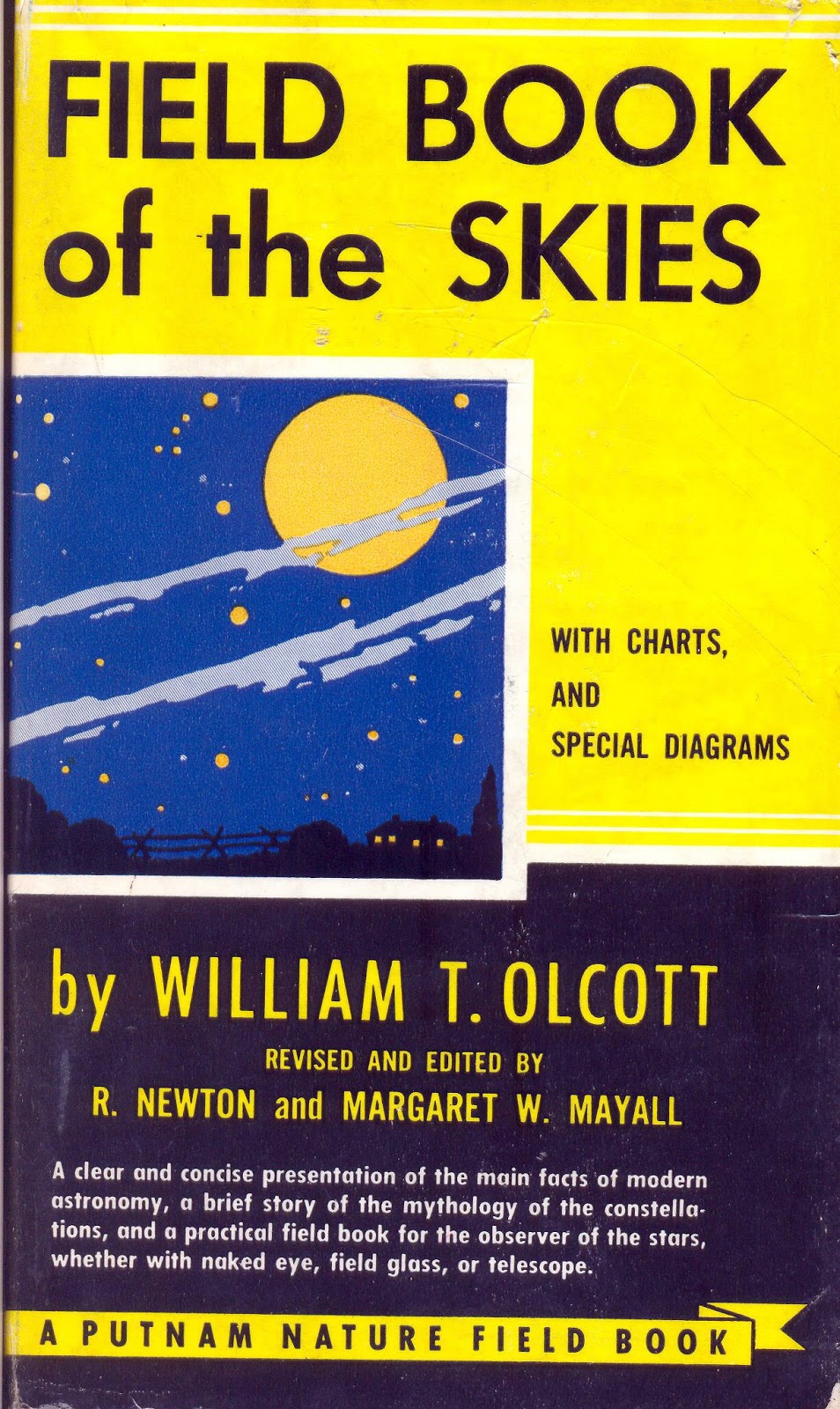
His project was to observe 50 objects with a 2" scope; ours is 60 objects, one for each dollar spent on the scope.  Like him, we will limit ourselves to only 10 lunar sites.  However, we are going to use William T. Olcott's "Field Book of the Skies" to select our objects.  So here we go!
 My own copy of this incredible book.

Object #1: Mizar, Ursa Major:  First light went to the Horse and Rider, Mizar (mag. 2) and Alcor (mag. 5).  Both stars were seen in the 5x20 finder.  At 30x there is a fainter star midway between the two naked eye stars, forming a triangle with them.  Deb then went on to split Mizar first (2.4-4/14"), at 30x.  My eyes were watery from the wind, but I eventually got it, too.  At 60x it is a beautiful object, with a possible slight colour difference, the fainter star yellowish and the primary white.  Star images seemed excellent, despite passing clouds and a lot of turbulence tonight.  Had this been the only object seen tonight, it would have been enough to tell us that we had a very good little telescope on our hands.  This was no toy.  Unfortunately, the wind hampered most steady views.  Olcott tells us that this was the first double star ever discovered, by Riccioli in 1850.  In 1889, Professor Pickering discovered that the star was also a close binary.  He goes on to say that the star has the distinction of being the first one photographed by Bond, using the collodion process (https://en.wikipedia.org/wiki/Collodion_process).  To us, it looked something like this at 60x, minus background stars:
http://www.perezmedia.net/beltofvenus/archives/000603.html

Mizar is a gem object in a good 2" glass, and we are glad we chose it to be our first object!

Object #2: Oc 457, Cassiopeia:  Mag. 6.4; 20'; Br. * mag. 8.6:  This object appears on Olcott's map of the constellation, south preceding Delta.  In the comments section he is rather concise:  "The cluster NGC 457 is an elegant group."  Who could resist a come-on like that?  In the 6" and 12" mirrors this is a great showpiece cluster.  What would it look like in a 2"?
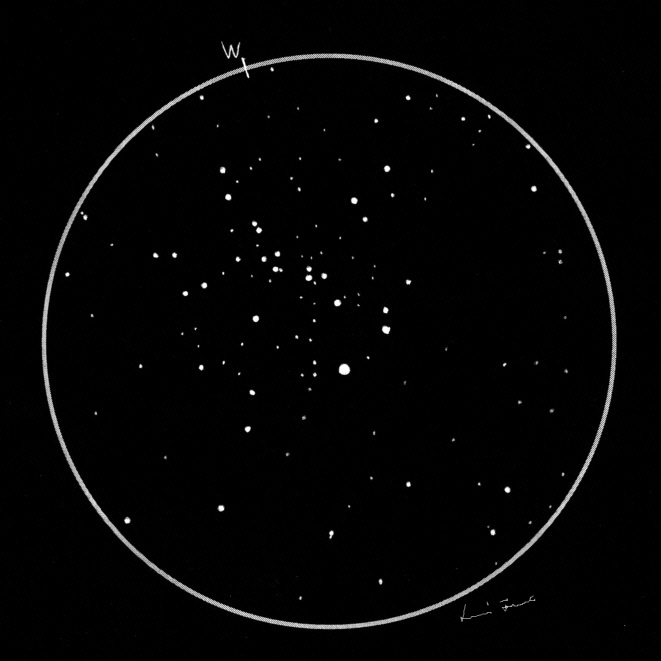
Despite several attempts at long looks at oc 457, the clouds and wind thwarted us.  30x showed us about a dozen bouncing stars, using averted vision.  60x gives a much better view, and many more stars can be seen.  However, we enjoyed our best views (a few seconds at a time) using my Epic 11 8 mm eyepiece, giving 75x.  I am not adverse to using other eyepieces, provided we used the given ones first.  It becomes pretty amazing at this range, with a ton of resolved stars showing clearly, along with the two brightest ones.  I did not have enough clear sky time to actually count stars, but there were more than 20.  Perhaps I will return on a better night.  However, it does seem that this telescope will shine prominently in the study of open clusters and double stars!  It looked a bit like this to us, only jiggly.
NGC oc 457
http://www.graphitegalaxy.com/index.cgi?showsketch=8 

Object #3:  Messier 15, Pegasus:  Mag. 6.3; 18'; Br. * mag. 12.6:  Easily picked up at 30x, the globular cluster appeared remarkably bright and concentrated.  60x will show the brighter star just north.  At this range the center is very bright and star-like, surrounded by a larger area of bright haze, and then again by fainter haze.  Obviously we will not be resolving many globulars with this scope, but the bright ones will be easy to see.  Olcott includes this as the only deep sky object on his telescope map of Pegasus.  His brief text line reads: "The cluster M15 was discovered by Maraldi in 1745."
 M15.  No stars resolved for us, but the star north could be seen.
http://www.astroimages.de/pics/gallery/full/M15-20080928.jpg

Object #4:  B Cygni (Albireo):  3.2-5.4/35":  Easily the highlight of the night, colours and star images were outstanding!  We have a winning scope on our hands!  Deep golden yellow and very blue, surrounded by a rich star field.  Viewed at 30x and 60x, in between the clouds.  Olcott claims yellow and lilac, and says "very fine."  He continues below the chart with: "Many consider B Cygni the finest double star in the sky.  Its contrasting colours, gold and blue, are very beautiful."
Albireo.
http://i1.wp.com/astrobob.areavoices.com/files/2013/07/Albireo-Chumack.jpg?resize=960%2C762

Object #5:  Alpha Ursa Minoris (Polaris):  2.5-8.8/19":  Olcott claims this to be "not an easy object in a 3" glass."  Ponder, then, the plight of the lowly 2" glass.  However, we split it!  I spotted it first at 75x, impossibly tiny and faint and quite close to the primary.  When it comes to star images and splitting doubles, refractors rule.  We were able to (barely) glimpse it afterwards at 60x, once we knew where to look (just above it in the eyepiece, as in 12 o'clock high).
Polaris
http://jeffreysboldlygoingnowhere.com/wp-content/uploads/2012/12/Polaris.jpg

Three doubles, an open cluster and a globular later we packed up our gear (3-4 minutes) and headed home.  We are now five objects into our 60-object Olcott project.  I hope you will join us for the rest of them in the coming months, under the heading "Adventures with a Small Telescope."  I doubt that a new astronomer on his/her first night out would have had our success, especially with the crappy weather.  Our long experience with telescopes, the night sky, reading charts, dark adaptation for the eye, and using averted vision all came into play.  We were able to turn an otherwise unusable night into a modest success!
 
Mapman Mike