Wednesday, 25 March 2015

#66 Treasures of Monoceros, Part 1: The NGC Clusters

It was another unusually brutal winter here in Essex Co., Ontario, Canada.  It was too cold for sensible observing until mid-March.  With night temperatures finally up in the high twenties and low thirties, I was able to resume my winter observing program.  I only have a few galaxies left to see in Lepus.  Perhaps on a very late night in November of this year I might be able to complete this constellation, which I have been at for several seasons now.

I recently concluded a multi-season inspection of the deep sky wonders of Monoceros, a busy Milky Way constellation.  Some of the most famous objects of the deep sky are located here, including the Rosette Nebula and the Cone Nebula.  Rich in open clusters and nebula, there are also two tiny galaxies and a single planetary nebula.  There are no globular clusters in Monoceros.  It also has fabulous double and multiple starsThis first entry will deal with all of the NGC Open Clusters.

oc 2215:  8'; Br. * mag 11; 25 *s:  Noticed at 60x.  Faint members, with a nice double star preceding.  150x shows the group well, with stars all across the field.
oc 2219:  10'; Br. * mag 7.3; 25 *s:  North preceding 2232.  Fainter stars lie N of two brighter ones.  Seen well at 120x, but located at 60x.
oc 2225:  40 *s:  Small group, not dense.  8 brighter stars in a half-circle, with fainter ones showing at higher powers.  Central core is 2226.
oc 2226:  See 2225, above.
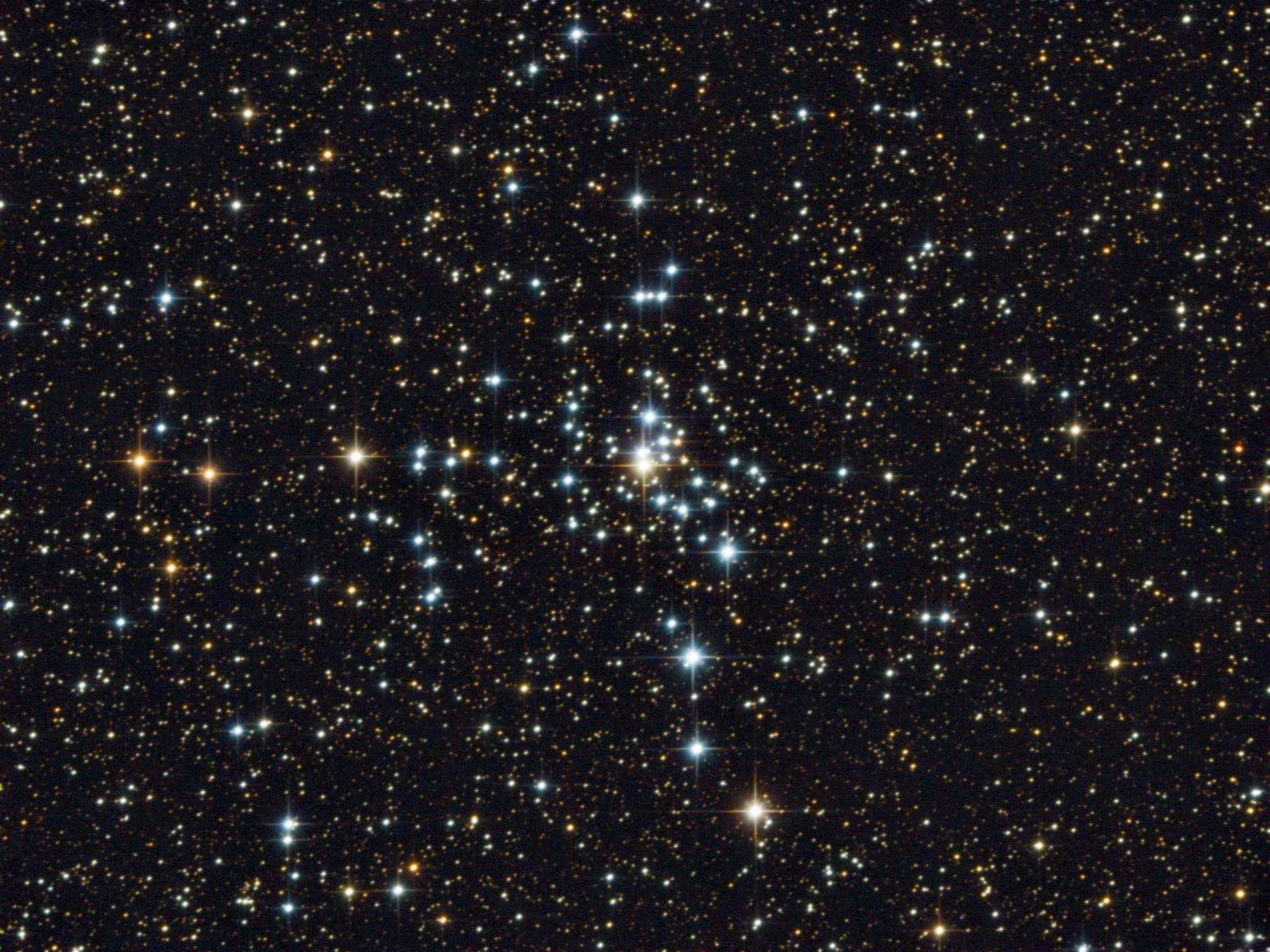
oc 2232:  45'; Mag. 4.2; Br. * mag 5; 20 *s:  A huge cluster, best suited for very low power.  Lovely at 43x in the 12".  The main central group is great at 60x.
oc 2236:  8'; Mag. 8.5; Br. * mag 12; 243 *s:  A very small, tight group that took a few moments to locate.  Only one bright star (mag 12), with the remainder being very faint.  Some resolution was apparent at 120x, and it improved at 150x.  At 200x the central knot is resolving.  Stopped to 8", very few stars are resolved in the central area.  Here is a photo.
oc 2244:  30'; Mag. 4.8; Br * mag 7; 100 *s:  15 stars shown on Uranometria!  Those are seen at 60x.  Nebula filter at 83x shows some fuzziness and nebulae.  120x shows many fainter stars.  I used up to 300x on multiple star GAn 3, where I could see 9 stars in all.
oc 2250:  10'; Br. * 8.7; 25 *s:  South following 2232, this one is also called Cr 100.  Moderately rich group with mostly very faint members.  Only one bright member, with the others S of it.  Best at 150x.
oc 2251:  10'; Mag. 7.3; Br. * mag 9.9; 92 *s:  North following and attached to oc Bas 8.  Located at 60x, there are about a dozen stars mag. 9-10, and several fainter ones.  The brightest star is a close double.  A loose group, somewhat crescent-shaped, or at least elongated.  Good views up to 125x.  In a very dense area of clusters and rich star fields.  Unusual and worth a stop, though not a showpiece.
oc 2252:  18'; Mag. 7.7; Br. * mag 9; 30 *s:  A bit of a showpiece in the 12".  Faint members form two distinct lines, meeting at an apex.  To me it looked like the Star Trek badge!  About a dozen brighter members, and many fainter ones.  Looking like a little hazy cloud at 60x, it bears magnification well.
oc 2254:  6'; Mag. 9.1; Br. * mag 12; 93 *s:  A very faint cloud was seen at 120x (in light polluted skies), barely resolving.  8" aperture showed perhaps two stars.  The group is intense, small and faint.  At 150x and 12" it began to resemble a loose globular cluster.  Small and dense at 200x, it was still resolving.  In this range it was hard to even see it using an 8" aperture stop.
oc 2259:  3'.5; Mag. 10.8; Br. * mag. 14; 25 *s:  A small, faint group noticed at 100x as a faint cloud near a mag. 9 star.  Up to 250x was used to resolve about 10 very faint stars.  Observed in a light-polluted area.  (Re-observed in a dark sky)--small, dense group seen well, resolving neatly and looking mildly glorious.  Still a challenge, but so much better in a dark sky!
oc 2260:  20'; Br. * mag 8; 50 *s:  6 *s in Uranometria Chart 116.  Seen well at 60x, it just barely fits in at 120x.  Bright star is orange.  Brighter stars form a sickle shape.  Large, bright and fairly scattered.
oc 2262:  4'; Mag. 11.3; 180 *s:  This is a small, dim circlet of faint stars, and not very rich.  An interesting group zigzags N from it.
oc 2264:  40'; Mag. 4.1; Br. * mag 5; 40 *s:  The Christmas Tree Cluster was studied with the 6" reflector, which was perfect for the task.  It all fits neatly at 28x, and the tree outline is there.  A very large cluster set amidst a very interesting area.  The brightest star in the group is 15, a multiple star.  It was split into three at 125x.
oc 2269:  3'; Mag. 10; Br. * mag 10; 12 *s:  10 stars were counted at 200x.  It is a very faint, small group.
oc 2286:  15'; Mag. 7.5; Br. * mag 9:  Once located within a busy star field, the cluster was quite a minor showpiece!  Though large, it was packed with stars, including several bright ones.  However, most of them are faint, and there are a lot of them.  125x seemed to give me the best view.
oc 2301:  15'; Mag. 6; Br. * mag 8; 80 *s:  A fine cluster!  At 60x 5 bright stars are noticed, resembling a dipper minus a handle star and a top right corner star.  The main part of the cluster is in and around the lower part of the "bowl" of the dipper.  Here it becomes dense with stars, with the final dipper star a lovely double of yellow and blue.  At 100x 15 brighter stars cluster around it, with another 25 fainter ones following seen at 125x.  183x shows many other fainter ones, resolving the haze first seen at 60x and 100x.  A recommended object!  Here is a link to a photo.
oc 2302:  5'; Mag. 8.9; Br. * mag 12; 16 *s:  16 stars were counted at 200x.  The group is tight, and has 3 close brighter stars that precede the fainter ones.  Star V 743 is immediately north preceding.
oc 2306:  20'; Br. * mag 8; 27 *s:  South following oc 2302 is this very large cluster.  Uranometria plots an 8 mag. star in the center, a 9.5 mag star in the north, and HH on the south-following edge.  At 60x I saw the bright stars and not much else.  100x showed the white central star now surrounded by faint ones.  The star in the north also has a group of faint stars around it, with a denser group between it and the central star.  The brightest star had about 15 widely scattered faint stars, while the dimmer one in the north has 12, in a tighter formation.  Observed in a light polluted sky.
oc 2309:  5'; Mag 10.5; Br. * mag 13; 25 *s:  North following oc 2306 is this small cluster, noticed at 60x.  Very faint stars were noted south of a mag. 9 star.  100x resolves the brightest members, forming a loose circle.  The very center resolves at 200x and 250x, where 25 stars were counted in a small area.  Other members straggle out from this central group.
oc 2311:  6'; Mag. 9.6; Br. * mag 12:  A fine cluster, viewed from 60x thru 200x.  It is dense and has an irregular north/south shape, with most stars in the north and others straggling south.  Everything resolves well at 125x.  It precedes three brighter stars in a line.
oc 2319:  16'; Br. * mag 8.9; 12 *s:  Seen well at 60x and 100x.  There were 25-30 stars, many of them bright, mostly in 2 straggly lines.  One of the lines is longer and denser.  Up to 125x was used, and all stars were resolved.
oc 2323 (M 50):  16'; mag. 5.9; Br. * mag 9; 80 *s:  The cluster is a wonder to behold at 60x in a 12" mirror, even in a light-polluted sky!  The brightest star is orange, and has a bright double star nearby.  A chain of bright stars outlines a large, open smile shape, with lines of stars passing perpendicular to it and thru its denser core.  The core lies near the center of the smile shape.  100x shows 100+ stars, including many faint ones.  The cluster is very rich, with 125x and 150x filling the viewfinder with stars, though there is a darker area between the orange star and the rich center.  200x takes the viewer into the very center.  A fabulous cluster!
oc 2324:  8'; Mag. 8.4; Br. * mag 12; 25 *s:  At 60x this cluster is already promising much!  100x gives good resolution of this faint, large and medium-dense cluster.  Beyond the main central group, the cluster spreads north a bit.  125x gives fabulous views, as does 150x and 183x, where most of the haze is resolved into tiny stars.  Viewing was good up to 200x.  A minor showpiece in a 12" scope!  Here is a good photo.
oc 2335:  7'; Mag. 7.2; Br. * mag 10; 40 *s:  Seen well and resolved at 100x, where I noticed 10 faint stars close to a brighter orange one.  At 125x the cluster was pretty large and scattered into 3 groups.  The central group was the most dense, with a preceding group and a following one less so, and with fainter stars.  I counted 30 stars at 200x.
oc 2338:  3 degrees north-following M 50, this is a virtually unknown group.  The Deep Sky Field Guide says it might be an asterism.  There is definitely a 4-star asterism present.  However, the cluster seems to be "behind" and around these stars.  The 4 stars make a rough parallelogram.  A medium-rich group of faint stars lies around it, in 2 distinct clumps.  The north-following bright star of the asterism is a close double.  Here is a photo of the lone Messier object in Monoceros.
oc 2343:  6'; mag. 6.7; Br. star mag 8; 55 *s:  I first mistook this for nearby Cr 465.  Along with Cr 466 all three clusters fit in a low power field.  20 stars were seen at 100x in the central group of 2343.  Like 2335, this cluster is dominated by a bright orange star, itself a fine double.  At 125x this is a pretty decent cluster.
oc 2353:  18'; Mag. 7.1; Br. * mag 9; 106 *s:  A fun cluster to observe, big and with a fair number of brighter stars.  Breathtaking at 60x, with too many stars to easily count.  Shaped like a big oval, this is a fine group for 6" scopes and higher.
oc 2364:  2 lines of brighter stars, looking like a mirror view at first glance and low power.  I focussed on the following group, which had 5 stars in a curving line.  2 of these were brighter.  150x gave a good view, and a few fainter members could be seen now.  At 200x 5 or 6 very faint members were added to the original 5 brighter ones.  The bright star field is pretty interesting, but the "cluster" isn't much to see.
oc 2368:  3'; Mag. 11.8; 15 *s:  Not a bad object in the 12", it is led by a bright star on its preceding edge (mag 11?), which turns out to be a double with a faint companion.  At 200x there are 20+ stars, all faint except the one.  It is somewhat triangular, or wedge-shaped.
oc 2506:  10';  Br. * mag. 11; 75 *s.  60x shows a dense central area.  120x resolves many of the fainter stars, and 150x shows the central knot well.  Bright foreground stars make resolving this one very challenging.  In a really dark sky, this cluster is a treasure!  Here is a link to a great photo of this object.

In Part 2 I will discuss the remaining NGC objects, along with the IC ones observed.  In Part 3 I will discuss the clusters from other catalogues in Monoceros.  Until then, clear skies.
Mapman Mike 

Thursday, 29 January 2015

#65 Cassiopeia Summary 3: Objects From Other Catalogues

There are nearly 60 clusters from other catalogues!  Lots to challenge the viewer here besides NGC and IC objects.  I have also included 3 great double *s.

oc Be 01:  5'.  15 stars at 150x.  Pendant on a necklace!  Pendant is the cluster.
oc Be 02:  2'. Brightest * mag. 15.  Very very small, very very faint.  4 stars at 250x.  Noticed at 100x.
oc Be 04:  4'. Brightest * mag. 18(?).  15 faint stars around a bright one.
oc Be 05:  5'.  Brightest * mag. 17.  A few mag. 12 *s overlay a very faint, irregular unresolved background haze.  Viewed at 100x-150x.
oc Be 06:  5'. Brightest * mag. 14.  Very tight, very small group of 8-10 *s, resolving at 200x and 250x.
oc Be 07:  4'. Brightest * mag. 14.  Resolves well at 125x, and includes several bright *s.  Nicely resolved at 200x.  About 20 *s.

oc Be 58:  8'.  Vis. mag. 9.7.  3rd member of group with 7788 and 7790.  25 stars along a zigzag line.
oc Be 60:  4'. Barely noticed at 60x  250x shows small circle, about 6 very very faint stars.
oc Be 61:  3'. Brightest * mag. 14.  Small, hazy patch at 60x.  Resolves at 125x upward, but very few stars. 
oc Be 62:  6'.  Brightest * mag. 13.  A dozen faint stars involved with a 5-star asterism.  Use high power.
oc Be 63:  3'. Brightest * mag. 15.  A faint haze was suspected and noted at 60x.  100x confirms the sighting, with averted vision.  125x-200x resolves 7 or 8 *s, best with averted vision.
oc Be 64:  2'.  brightest * mag. 14.  Sparse and faint.  Resolves at 250x.  2 *s at mag. 14, with others very faint.  2 close sections resolving, though very few *s.  Seen in a moderately light-polluted sky.
oc Be 65:  5'.  Observed at 125x and 150x, 12-15 *s were resolved just north of a somewhat brighter group that has a dipper shape.

oc Be 102:  5'. 8 stars in faint cloud N of triple star.  Also a double *.
oc Be 103:  4'.  Threshold group begins to resolve at 150x. 6 very faint *s.
oc Be 104:  3'.  Brightest * mag. 16.  South of star V639.  6 stars resolved at 250x, hampered by the variable.

oc Cr 034:  25'.  Even larger than nearby IC 1848, this one is viewed best at 60x.  A bright pair lies in the center, and intersecting lines of faint *s pass through, giving this cluster its identity.  The bright central * has 7 faint companions at 100x.  Moderately rich but widely scattered. 
oc Cr 463:  A huge group, best at 43x.  Widely scattered but rich in bright stars.  Orange and blue double following.  Extension of main cluster preceding.
oc Cz 01:  3'. 8 tiny, dim stars at end of brighter line of slightly curving stars.
oc Cz 02:  10'. Mostly resolved at 100x.  25 stars at 150x.  Large and dim at 60x.
oc Cz 03:  1'.5.  Visual mag. 9.9:  A faint haze surrounding a mag. 10 * noted at 100x.  200x shows 3 or 4 *s, very very faint.
oc Cz 04:  4'.  10 faint *s counted at 200x, around a much brighter one.  Same high power field with Tr 1.
oc Cz 05:  2'.  Not even spotted until 200x was applied!  Extremely faint, small cloud of *s noted, with a few resolving.  Good luck even finding this one!
oc Cz 06:  2'.  Located at 60x, a bright * was seen with haze.  At 250x 9 *s could be counted, most very faint.
oc Cz 07:  4':Between 2 close bright *s.  8-10 *s resolved, mag. 14-16.
oc Cz 09:  10'.  Noticed at 100x, I saw 2 bright *s involved with a large cloud of very faint *s.  about 12 *s.
oc Cz 10:  4'.  Small group of very faint *s, with 8 counted at 200x.  A brighter, richer asterism is almost adjacent.
oc Cz 13:  4'.  Brightest * mag. 12.8.  Spotted at 100x as a very faint cluster of tiny *s.  The group is still resolving at 200x and 250x.
oc Cz 43:  6':  Double cluster with M 52, but fine on its own.  Low x shows both.

oc Do 13: Large and widely scattered group.  About 40 stars at 100x, many of them bright.  Attractive group.  Immediately south preceding at mag. 5 *.
oc Do 46:  12'.  Brighter white star surrounded by a large cloud of very faint *s.

oc Fr 01:  Brightest * 10.6.  5 bright stars and a dozen faint ones.  North preceding NGC 7788.

oc Ha 21:  3'. Mag. 9.  Seen well at 125x. 5 bright stars with some very faint ones.  Situated between 3 brighter *s.  Seen well at 125x.

oc King 01:  9'.  Brightest * 13.  Very faint at 60x.  150x shows 16 stars in 2 groups.  A bright group is adjacent.
oc King 02:  4'. Brightest * mag. 17.  3 stars at 200x. Very small, very faint haze near bright, compact group.
oc King 04:  5'.  Brightest * mag. 13.  A decent cluster with nearly 20 *s resolved at 100x-200x.
oc King 12:  3'. Brightest * mag. 10.  A true cluster. 200x shows 15 stars around a close double.
oc King 13:  5'. Brightest * mag. 12.  Very small, very faint.  About 12 stars near a brighter one.
oc King 14:  The best of three close clusters, all appearing in a 100x field.  Largest of the three and most interesting to view.  150x shows 30+ stars.  oc 133 is hard to identify.  Look for 4 bright stars in an uneven N/S line.  The 2nd star from the N is a close double.  13 stars seen at 250x.  oc 146 is just preceding.  An 11.6 mag. star lies at the center of a faint, hazy cloud at 60x.  25 stars resolve at 150x.
oc King 15:  3'. Brightest * mag. 18 (?).  I saw a moderately rich group at 125x, surrounding a gold star.
oc King 16:  Spotted at 60x.  I have named it the "Martini Glass Cluster."  Resolves nicely at 150x.  At 250x 15 *s are noted, including the 5 brightest outlining the glass shape.
oc King 20:  4'.  4 11 mag. *s amidst small cloud of mag. 13 and 14 *s.
oc King 21:  An impressive number of stars can be seen at 125x and 150x.  The cluster is near a bright triple.
 
oc Mayer 01:  8'. Curving line of stars, S-shape, about 25.  Curious group, with a bright * on the edge, and a bright triplet just off the edge.

oc Mrk 06:  6'.  Vis. mag. 7.1.  Observed at 60x and 120x.  A group of about 12 *s, most of them pretty bright.  Not small.  Quite suitable for smaller scopes. 

oc Skiff j00584+6878:  7'.  Brightest * mag. 10.2.  125x begins to show a dozen stars, widely scattered.  Located out of the way.
oc SkiffJ23302+ 6015:  Small, very faint cloud.  6 or 7 faint stars.
 
oc St 02:  60'.  Brightest * 8.2.  On the border with Perseus, this group is an utter wonder at 43x!  The eyepiece is filled with bright stars in a dense field.  Great in the 6" scope, too.
oc St 03:  5'. Brightest * 11:  9 *s seen in a central area. 
oc St 05:  Another large, scattered cluster good at low to medium power.  Contains a star circle, and V781, an orange star.  Fine for all apertures. 4 bright *s frame this moderately rich group.

oc St 11:  10'.  10 white stars.  Triple star within.
oc St 12:  30'. Very large.  15 bright stars plotted on Uranometria.  I saw 40 bright ones at 43x.
oc St 18:  5'.  Line of 5 bright stars.  2nd from west surrounded by faint stars.
oc St 19:  3':  Viewed up to 250x, 6 *s were seen.
oc St 21:  4'.7. Brightest * mag. 12.  A 'V' shaped * group was noted, open end to the northwest.  The line in the south (running east-west) had a compact group of very faint *s around it, the actual cluster.  However, the whole group was attractive in the 12".  Resolved at 150x.
oc St 24:  5'. Brightest * mag. 13. 200x shows 9 faint stars.  Very close double involved, equal mag.

oc Tom 04:  5'.3.  Brightest * mag. 16.  The cluster is not small, and beginning to barely resolve at 100x.  Good at 125x with decent resolution at150x.  Not many *s, and all very faint. 

oc Tr 01:  3'. Brightest * 10.  North preceding M 103.  2 lines of converging *s, one line bright and the other dim.  Like a "V" without the apex.  Bright line contains 2 doubles, both at the bottom.  Faint line has a double at the top.  12 *s at 200x.  Same high power field with Cz 4. 
0c Tr 03:  15'.  Vis. mag. 7.  First seen at 43x, this a large, bright and attractive group, well worth the detour.  Lovely at 60x and 83x, too.  60 *s at 100x.  Recommended.

A few outstanding double stars are included.  These are not to be missed.

WZ:  7.5-8/58":  Orange and blue.  A breathtaking sight at 60x!
N (Eta): 3.5-7.5/11":  Yellow and deep orange at 60x.  Wow!
i (iota):  4-7/8":  A triple!
                -8/7".3:  Lovely triple * at 100x, not to missed.  Yellow, gold and blue.  Stunning object, even in the 6". 

Mapman Mike 


Wednesday, 28 January 2015

#64 Cassiopeia Summary 2: Other NGC and IC Objects

In addition to the 29 NGC open clusters discussed last time, there are an additional 7 NGC objects in Cassiopeia.
eg 0147:  13'.2 x 7'.8:  Visual 9.4; Sur. br. 14.5:  This whale-sized galaxy was viewed on several occasions, along with its neighbour 185.  Both are part of the Andromeda Family.  At 43x, 147 is oval and enormous, lying amidst a rich star field.  Dark skies and adapted eyes are requirements for good sightings.  At 59x it shows an inner oval area brighter than the outer area of haze.  100x shows the object well, including 3 *s within.  At 125x mostly the brighter central area was only seen.  This is a faint object, so wait for good skies, and be patient.  It is not a problem for an 8" or a 12".
eg 0185:  8' x 7':  Vis. 9.3; Sur. br. 13.7:  Much easier to view than its near companion 147, then both fit into my 43x field of view.  Quite bright and somewhat oval.  Averted vision shows the full extent of this very large galaxy, with a few *s involved.
eg 0278:  2'.1 x 2':  Vis. 10.7; Sur. br. 12.1:  Despite being a poor night for galaxies (lots of dew) the galaxy was large and bright at 60x.  It appeared slightly oval.  Central core much brighter at 150x.  Good object for 6" scopes, too.
gn 0281:  35' x 30':  This emission nebula was seen well at 60x with an Orion Skyglow filter.  It is very large, with some areas showing more brightness.  100x also shows it well.
gn 0896:  10' x 10':  Emission nebula, paired with IC 1795.  Both seen at 60x with the Skyglow filter.  Two distinct patches of very faint nebula, they were like seeing galaxies.  896 is brighter, with 2 faint *s north,  IC 1795 is involved with a 9 mag. *.
eg 1343:  2'.6 x 1'.6:  Vis. 12.8; Sur. br. 14.2:  Located at 125x and also observed at 150x and 200x.  Very faint overall, though it had a brighter and wider middle.  Elongated, with 2 faint *s following.
gn 7635:  15' x 8':  The "Bubble" Nebula isn't much to look at with a telescope, even with a nebula filter.  One star sits within it, at mag. 8.5.  Attached to and north of this star is some wispy gas.  Magnificent area for sweeping, and close to M 52. 

Cassiopeia has several noteworthy IC objects.  I observed all the ones listed in Uranometria 2000, ten in all.

 eg IC 0010:  6'.4 x 5'.3: Vis. 11.2; Sur. br. 14.9:  Located with just a bit of trouble, the galaxy was seen tonight at 60x and 100x, just north following variable * TV and its wide companion.  The galaxy was large, faint and oval.  A * was seen near the center, and other *s were also involved with the haze.
gn IC 0059:  10' x 5':  This was seen as a fairly solid block of nebulosity, large and especially noteworthy near a faint circlet of *s.  It was seen with and without the filter.
gn IC 0063:  10' x 3':  Separate from IC 59, and seen as more clumpy.  Just as faint as its companion.  
oc IC 0166:  8'.  Br. * mag. 17:  Immediately preceding a mag. 9 * lies a cloud of extremely faint haze.  Not large, but appears to be very dense.  A few *s resolved at 200x.  Well beyond what a 12" mirror can resolve.  However, I have seen it now with a friend's 22".  Still hard to resolve, but doable.
pn IC 0289:  48"; Vis. mag. 13.2; Cent. * 15.9:  Located at 60x and 120x with the filter, good views were had up to 250x.  It is round, large and ghostly and faint.  No detail can be seen.
oc IC 1590:  4'. Br. * mag. 9:  The cluster is within gn 281.  At 100x the brightest * in the nebual is a close triple system.  Up to 200x was used to see a few very faint stars around it, plus several brighter ones.
pn IC 1747:  19"; Mag. 12; Cent. * mag. 15.4:  Spotted at 100x, it was medium bright, round, small but very distinct.  Viewed up to 250x with a nebula filter.
gn IC 1795:  40' x 20':  See abstract for ngc 896, above.
oc IC 1805:  20'.  Br. * mag. 7.9:  Though hardly a showpiece, it is a large, fine group with many bright members.  60x and 100x were used, with 100x showing an inner circlet of *s in the center quite well.  This central ring gives the cluster its main interest and uniqueness.  Very faint nebulosity could be seen using the Skyglow filter. 
oc IC 1848:  18'. Vis. mag. 6.5:  A wonderful cluster at 60x, with 2 bright *s in the very center.  The brightest one has 3 faint companions.  The 2nd brightest * has about 10!.  125x resolves the cluster, a very large group with several bright *s and many faint ones.  Though a rich group, it is scattered.  60x and 83x shows the group well.  With a Skyglow filter there is some faint, thin and wispy nebula.  Recommended.

In the third part of my Cassiopeia review I will take a look at the many non-NGC/IC objects in that constellation.  To be continued...

Mapman Mike

Tuesday, 27 January 2015

#63 Cassiopeia Summary 1: NGC Open Clusters

     I will say something about each and every deep sky object observed in this most wondrous constellation.  I began observations in August 2013, and had just a few objects left to finish in August of 2014.  Many of the comments have been taken from previous Monthly Summary blog entries, but there is a significant amount of new detail.  There are 29 NGC open clusters, and I will discuss them in numerical order.

oc 0103:  5'.  Brightest * mag. 11.  30 stars on a stem with a branch.  Haze at low x, with 4 *s.
oc 0110:  19'. Brightest * mag. 9.7.  83x shows 60+ *s in this large, bright group.  A bright orange * is following, and a wide double south of it, yellow and mauve.  Medium rich even under a 1st quarter moon.  A low x beauty.
oc 0129:  12'. Brightest * mag. 11. Large group seen well at 60x and 83x. 35 stars near a triangle, with more further.  Rich group.
oc 0133:  3'. Mg. 9.4.  4 bright *s form an uneven north/south line, seen well at 60x.  2nd * from the north is a close double.  13 *s counted in a small area at 250x.  Adjacent to 146 and King 14.
oc 0136:  1'.5.  Brightest * mag. 13. 8 stars resolved at 250x.  Haze at low x.  Very tight and faint.
oc 0146:  5'. Brightest * 11.6.  An 11.6 mag * sits at the center at 60x, surrounded by a faint hazy cloud.  125x resolves most members, with 35 faint *s counted at 150x.  Adjacent to 133 and King 14.
oc 0189:  5'. Brightest * mag. 10.9.  Medium rich, dense.  Near a mini-Cepheus, and oc 225.
oc 0225:  15'. Brightest * mag. 9.3.  40 stars at 83x.  Good for 6" and up.  Large and bright.
oc 0358:  3'. Asterism of 4 stars.  Faint group south, involved with a 2nd asterism.
oc 0366:  4'. Brightest * mag. 10. 4 bright and 4 dim stars at 200x.
oc 0381:  7'. Brightest * mag. 10. 30+ stars at 150x, resolved well.  Dense group.
oc 0443:  4'. Brightest * mag. 9.  At 125x I observed a mag. 9.5 orange * closely surrounded by a cloud of tiny, faint *s.  200x shows 12 *s immediately surrounding the bright one, but there are many more in a wider area, using125x.
oc 0436:  5'. Brightest * mag. 10.  Little brother to oc 457, it is very close and an easy star hop away.  Both objects seen together at low x.  30 *s at 150x. 

oc 0457:  Stunning object in virtually any instrument, this one does require a low to moderate power.  For my scope 83x was the ideal range.  I also saw it well in Deb's 6" at 84x.  Highlighted by 3 bright stars, it is a moderately rich group.  Worth coming back to often.  Makes a nice showpiece for star parties or beginning observers.  
oc 0559:  7'. Brightest * mag. 9.  100x resolves a rich, dense group.  Up to 250x shows about 50 *s.

oc 0581--M 103:  6'. Brightest * mag. 9.  Not an object to hurry over, especially with a 12".  Not as instantly likeable as M 52, nor as many stars, but it is still beautiful and quite rich.  The cluster remains bright, even at higher powers.  A yellow star on one end, an orange one near the middle and a triple on the opposite side of the yellow one make a nice beginning.  The cluster is quite dense but don't be put off.  Even a 6" shows the group well.
oc 0609:  3'. Brightest * mag. 14.  Located at 60x with averted vision, it is confirmed at 100x, but still haze.  125x begins to resolve this tiny cluster.  A challenging object to observe.
oc 0637:  3'. Brightest * mag. 8.  7 brighter *s seen at 100x, some in a curving line.  Fainter members resolve here with averted vision.  Up to 300x shows a circular, torque-shaped group with a dense knot in the preceding section.  There are 20 to 25 *s.
oc 0654:  Already rich and dense at 60x, the stars swarm around a yellow 7.5 mag. star.  This reminds me of a Berkeley cluster on steroids!  High power shows 30 faint members.
oc 0657:  7'.  Brightest * 7.1.  A dozen bright *s seen preceding a lovely bright, wide double, yellow and blue.
oc 0659:  6'.  Brightest * mag. 10.  Near a bright triangle of *s.  Curving line noted, encircling faint haze.  Two circles of stars, attached in the middle, with about 25 *s in their middle sections, mostly faint.  Resolved at 200x.  
oc 0663:  15'.  Brightest * mag.9.  An outstanding cluster in my 12" mirror!  Large and bright, I viewed it at 60, 100 and 125x.  Though a major showpiece in my scope, it is bright enough to be appreciated in almost any aperture.  A rich cluster, highly recommended.  Two pair of double stars, one on either side of the group, add interest.  Easy sweeping to 654 and 659.
oc 0743:  7'. Brightest * mag. 10.  Wedge-shape at low x.  Compact and medium rich.  Dense inner section resolves at 100x.
oc 0886:  14'. Brightest * mag. 11.  Framed by 2 *s, mag. 8.5 and 9.  12 cluster *s relatively bright, with many faint ones also.  25 *s counted in 2 wide lines.
oc 1027:  15'. Brightest * mag. 9.  Lovely at 60x, with a white mag. 7 * in the center, along with a 9.7 mag. pair.  Many other fainter *s surround these 3.  Large and scattered.  About 60 *s at 100x, mostly white.  There is a double line of *s, crescent-shaped and faint, following the main *.  Fine object.
oc 7654/M52:  16'. A deep sky wonder!  60x shows well. 125x resolves all. Also see Cz 43.
oc 7788:  4'.  Cone-shaped.  Pair with larger 7790.  20 *s at high power.
oc 7789:  25'.  One of the finest ocs!  For 6" or higher.  Do not miss!  Uncountable stars in 12".
oc 7790:  5'.  A must with a 12".  Middle of 3 clusters, including 7788.  Medium rich at high x.

...to be continued 
Mapman Mike


Saturday, 17 January 2015

#62 2014: A Look Back

     It's now been just over two years since I purchased my Orion 12" Intelliscope and threw myself headlong back into amateur astronomy.  The past two years have been packed with fun and adventure, and in a month or two things will start again in earnest for hopefully another banner year.  Although my focus will continue to be the NGC catalog, I will explore all corners of a constellation, leaving no deep sky object or outstanding double star unobserved.
     
     2014 was an incredible year for my unique observing program, and for sheer number of nights of observing and total number of hours, it comes in second only to 2013.  I have been keeping records of my observations since 1968, and have had many very good years in there.  However, nothing compares to the quantity and quality of observations over the past two years.  Those two years have both had crappy beginnings (January is a fearsome month in Canada) and endings (November and December both years have been unbelievably cloudy, except near the full moons).  The middle parts of a year are sometimes not so great, either.  However, when we do get a good month, it can mean many hours of observing, including several nights in a row.  I am fortunate in that I can usually make use of any available clear night.

     So, what made 2014 special?  I set up the scope and observed 52 times!  Considering that there are about 180 available nights for some moonless observing, that means the ratio of clear nights to cloudy is about 1:3.6.  Not exactly ideal for a rabid astronomer, but it's the best Nature can do for me.  During those 52 nights, I stayed out for 165 hours of intense observing; on average just over three hours per session.

     In that time I was able to observe no less than 437 deep sky objects!  That's even better than last year, so my skills at locating objects have improved, and so has my observing eye.  Practice does make one better!  That's 2.6 objects per hour of observing, so I am not hurrying through the sky, but rather taking my time and enjoying the view, whatever might be in the eyepiece.

     How am I doing with my NGC project?  I observed 248 new (to me) NGC objects, and 27 from the IC.  In addition I was able to observe 83 objects from other catalogs, all listed on Uranometria 2000 charts.  I also reviewed 79 NGC/IC objects with the 12" that I had seen previously with my 8" Edmund reflector.  I do not yet have a final count of how many NGC objects I have logged in my life, but I am working on it (990, as of the end of 2014).  Also, I am working on a list of how many of these objects are possible from my location.  It's one thing to say that there are 7800+ objects up there, but many of those are in southern latitudes.  So I am compiling a to-do list of how many I can see from my latitude (42 degrees N).  I will report both of these figures in a future blog once they are complete.  I'm guessing that my life list is now at around 1,000 NGC objects, though likely short of that figure.

      What were the observing highlights of 2014 for me?  Certainly one had to be my increased skill guiding my scope and locating very faint objects.  I have been doing this for years now with my right eye, which is deteriorating rapidly due to a cataract.  I used to observe with my left eye, but it developed a cataract that ripened very quickly.  It (the cataract) was removed in November, so I am hoping to begin using a near-perfect eye for observing in 2015!  The limited amount of observing I have done with it already is very encouraging.  So finding faint fuzzies might be easier than ever in 2015!

     I made progress in Lepus and Monoceros towards the end of last winter, and hope to do so again this year.  Monoceros is so loaded down with fine objects, though most people only observe a few of them.  My jaunt through this area has been most rewarding, even though in winter I am usually stuck on my back deck, which is seriously light-polluted.

     In Spring my attention turns to Leo and then to Bootes, and last year it was a great year for both constellations.  Leo, sadly, passes through the Spring skies at breakneck speed, and it will take me years and years to finish work here.  Bootes, on the other hand, stays up there well into summer, so I should be able to finish up work here in two or three years.

     Last summer I was able to redo three constellations that I had very much enjoyed seeing with the Edmund 8".  Aquila, Delphinus and Sagitta are wonderful areas to explore with a 12" scope, and I really took my time observing here, even finding some of the faintest galaxies imaginable.  Resolving M 71 almost to the core was certainly a highlight for me!  Then I began work in Sagittarius, and I can't wait to get back here in 2015.  This might be my favourite constellation--it is loaded down with many of the finest deep sky objects anywhere, and I can access most of them from my latitude.  There are a few faint galaxies that will have to wait for a more southerly site.

      When autumn came around I finished up a few objects in Cassiopeia, then moved on to Cepheus.  I still have to do a summation essay of my work in Cassiopeia (watch for it here soon), and I have one page left to complete in Cepheus (about eight or nine objects).  I inched along in Cetus, and even did a bit of work in Taurus before the weather obliterated observations for the year.

     Finding a particular highlight is not possible.  Many of the nights were superb, and almost magical in their transparency and seeing.  It's the best possible feeling when you are setting up at sunset and you know it's going to be a great night!  Those are the nights that make the hobby worthwhile, and keep me coming back hoping for more of the same.  Whenever the weather clears up and warms a bit, I will resume work in Lepus and Monoceros.  I am anxious to get going, and hope that February will offer at least a few opportunities to observe without freezing conditions.  Usually I am fine for several hours if it isn't much colder than 25 F.  Much colder than that and things become more complicated, especially trying to keep fingers warm while changing eyepieces, scribbling notes and sketches, and keeping batteries alive on flashlights and the push-to computer.

     Clear skies to everyone hoping to observe in 2015!
Mapman Mike


Friday, 7 November 2014

#61 Sagitta: Deep Sky Objects Report

     To get a quick look at what Sagitta has to offer, see my blog entry for July 27th, 2014.  All objects listed there are covered here in detail, except for double stars.  I covered about half of the objects on the night of September 22nd.  The constellation highlight is M 71, a globular cluster that resolves well in a 12" mirror.  However, there are a few minor gems, too.

pn 6886 (10"; V. 11.4 mag.; Cent. * 18 mag.) was identified at 120x with a Skyglow filter.  200x and 250x show it as bluish in color, and bright, with a very small circular disc.  It is accompanied by two bright stars, each one a double with a faint companion in opposing position angles.

http://www.ngcicproject.org
 
pn I. 4997 (13"; V. 10.5 mag.; Cent. * 14.4 mag.) was also identified at 120x with the filter.  It was the northernmost of two bright stars.  It was slightly bluish.  It was very bright at 250x. The central star could not be seen clearly due to the brightness of the nebula, which is slightly larger than stellar.
pn 6879 (9"; V. 12.5; Cent. * 14.8) was identified at 120x using the Skyglow filter.  At 200x and 250x it shows a tiny, fairly bright disc.  The central star is seen steadily at 250x without difficulty.
http://www.ngcicproject.org
oc 6839 (4'; 12 *s) was new for me.  It is listed as an asterism (a chance lining up of stars).  Even so, I saw 15 stars at 100x, preceding a lovely bright star chain.  The brightest four members resemble an asterism, but some are double.  Adding on a faint group in the south end adds up to an open cluster in my estimation, though a minor one. 


http://www.ngcicproject.org
 
oc Harvard 20 (8'; V. 7.7; Br. * 8.9 mag.; 28 *s) is mostly resolved at 60x.  It was quite lovely at 100x, with two bright stars involved.  At 125x 35 stars were counted, several very faint. Members are fairly scattered.  It appears in a low power field with M 71.
gc 6838--Messier 71 (7'.2; V. 8.4; Br. * 12.1) already is resolving well at 43x.  Oc Harvard 20 is in the same field, south.  At 60x the globular cluster's center seems offset, south preceding. 100x shows resolution all across the object, plus some core detail.  At 125x the south preceding side is brighter, with the north following side darker (though still busy with stars).  187x shows dozens of stars, along with plenty of core detail.  The cluster now appears elongated.  I went as high as 375x, almost resolving the entire cluster!  Only a tiny bit of core haze remains!  This is a great object in a 12" mirror, and it appeared outstanding at all magnification ranges.
http://www.ngcicproject.org

     I completed work in Sagitta on September 24th.  I was unable to locate gc Pal 10.  Four small clusters finished up my work here.

oc Ro 1 (3'; 15*s) was located at 60x.  100x shows three bright stars leading into a hazy center. At 150x the 3-star chain expands to 6, several of them double.  187x shows 15 stars in a very tight group.

oc Ro 3 (5'; 20*s) was a circlet of 9 stars at first, including four in a tight knot.  Only two stars could be seen in the dark center.  187x shows about 25 stars, including faint companions to a few of the brighter members.  The north one is multiple.

oc Be 44 (2'; Br. * 16 mag.; 30*s) was located at 125x.  It was a small, faint hazy patch preceding two very faint stars.  There is not much to see here in a 12" mirror.

oc Be 47 (3'; Br. * 16 mag.; 20*s) was observed at 200x as a tiny, faint haze near a triangle of faint stars, all preceding a bright star (mag. 9.5).

     These six recent blog entries describe my major summer work in Aquila, Delphinus and Sagitta.  Last year I completed work in Lyra and Cygnus.  Work in Sagittarius has begun, but may take all of next summer to complete.  I am also working in Pegasus, Perseus, Cetus, Cepheus, Lepus, Monoceros, Leo and Bootes.  When each is completed, I shall report my findings here. Cassiopeia was recently concluded, and will likely form the next major segment of the blog. Cepheus is nearly done; two good nights in November should see me complete studies there.
Mapman Mike

#60 Delphinus Deep Sky Adventures, Part 2 (Conclusion)

     Welcome to the exciting conclusion to the deep sky objects of Delphinus, as seen through the eyepiece of a 12" reflector.  Well, maybe not exactly exciting.  Delphinus does not have a big showpiece object, but there are a few minor treasures.  Here is one of them...

gc 6934 (7'.1; V. mag. 8.9; Br. * 13.8) was located at 60x, in a line of four bright stars.  The first night I observed this object, it was just getting quite damp.  100x resolved a very few stars, and the globular cluster was very granular.  187x began to give fair resolution of the outer haze. The now stellar core is very bright, with a massive amount of less bright haze surrounding it. Lastly, a large area of even fainter haze surrounded all.  Having said that, the cluster is compact and tight, not easily giving up its stars.  More resolution comes at 200x, and the core still blazes with brightness.  I observed it again the following night, which was much drier.  It was now quite magnificent!  Stars resolved to the core, and up to 250x was used to very good effect, showing many more stars than last night.  A decent object in a 12" mirror.
eg 6944 (1'.5 x 0'.6:  V. 13.8; SB 13.4) was an easy object to view at 125x, even though it lies close to a bright star.  It is pretty large, elongated strongly NE to SW, and 187x shows a bright, stellar core.  More difficult is its nearby partner, eg 6944A (0'.9 x 0'.7:  V. 14.1; SB 13.5).  It was very elusive, even on a fine night.  Like its parent, it lies close to a bright star (even closer, in fact).  Only the core area is glimpsed with averted vision at 187x, so look for something much smaller than its stated dimensions.
eg 6988 (0'.5 x 0'.5:  V. 14.6; SB 13) is very faint, small and round.  This elusive object was seen with averted vision at 200x.  I also used a pinpoint hand-drawn chart to locate it (see my recent entry on using strategy to find faint galaxies).

pn 6891 (21"; V. mag. 10.5; Cent. * 12.4 mag.) is small, but easily located at 60x.  It was then confirmed at 120x with a Skyglow filter.  At 250x the object is very bright and bold, the central star being surrounded by a bluish-grey haze.  Two faint stars precede it, and another follows.
pn 6905 (72"; V. 11.1; Cent. * 15.7 (?)) was located at 60x, nestled in a loose, bright field of stars.  At 187x the central star appeared.  There is wispy detail in the nebula, too.  It was seen best with no filter.  Up to 375x was used tonight with success.  This is an unusual and recommended object, due to its large size and apparent brightness.  I question the given central star mag., as it was even seen back in the day with my Edmund 8".  Perhaps mag 13.7??
oc 6950 (14'; 60 *s) was swept up at 60x, being a large, loose group.  However, it does have a somewhat dense center.  Fully resolved at 100x, it is a bright and cheerful-looking group of stars.  There is superb sweeping in the immediate area. It is easy to hop to Alpha from here, and the rest of the dolphin shape.  At 43x (2" eyepiece) it is a noteworthy cluster, recommended for 8" or higher.  It is the only NGC open cluster in Delphinus.
eg 7003 (1'.1 x 0'.8:  V. 13; SB 12.7) was located at 60x, at the south preceding end of a string of four bright stars.  Confirmed at 100x, using up to 200x shows a large, oval patch of faint haze. A faint star is following the object; another one is south.  This is one of the less dim galaxies of Delphinus.  A good 8" scope should find it.
gc 7006 (3'.6; V. 10.6; B * 15.6 mag.) was located at 60x.  It was pretty large, round and ghostly, reminding me of a giant planetary nebula.  Up to 250x was applied, but no stars resolved.  It was still pretty bright, though.  Two very faint stars are south.
oc French 1  (13'; Br * 8.8 mag.) provides a nice little surprise, being a bright, large cluster observed at 60x and 100x.  There are about 25 stars, half of which are very bright and white. Four stars are plotted within its boundary on Uranometria Chart 83.  This is a pleasant stop, and it was also observed successfully in the 6" reflector.  It is easy to find with a push-to computer, as it is adjacent to eg 7025 (see below).
eg 7025 (1'.9 x 1'.3:  V. 12.8; SB 13.6) is not difficult to find.  A mag. 9.7 star is on the west edge of the galaxy, within oc French 1 (see above).  Spotted easily at 100x, it also looked fine with the aperture stopped down to 8".  In fact, we managed to glimpse it in Deb's 6" scope at 125x, once we knew where to look!  It was an exceptionally fine night.  The galaxy was oval and pretty bright, and had a bright center.  Despite the attached bright star, it is an easy object.
eg I. 1359 (1'.2 x 0'.4:  V. 13.9; SB 12.9) was located at 100x and confirmed at 125x.  It was a long, thin slash following two faint stars.  The view improves at 150x and 187x, but the oject is very faint at 200x.

     Last, and certainly least, I returned to the area of eg 6927 to hunt down its tiny, very faint companion eg 6927A (0'.4 x 0'.2:  V. 15.5; SB 11.8).  This one is tricky, and for experienced observers only!  Using a hand-drawn pinpoint map to help me identify it, this tiny, faint object was seen with averted vision at 200x, just south of 6927 (see previous blog entry).  While here I also reviewed 6927 (not that difficult tonight), 6928 and 6930 (always difficult).  All four galaxies were seen at 200x.

This concludes deep sky studies of Delphinus with my Orion 12" Dob.  Next up is a brief look at Sagitta.
Mapman Mike