Sunday, 16 August 2026

#155: A Few Useful Websites, and Messier 3

 I use a handful of websites to aid in my astronomy planning.  To me the most useful one is any weather app that shows past, current and future cloud cover.  I want to see for myself where the clouds are and what they are up to.  Astropheric is good, and their app is pretty decent, too.  Next in importance for me is Telescopius.  I use this to prepare myself for faint galaxy searches, drawing by hand the area around a faint object in the hopes of getting there easier with the scope.  My push-to computer gets me in the vicinity, but to pinpoint the exact location of a 14th mag. galaxy requires a lot more than being in the vicinity.  The site is also useful for providing info on the degree above the horizon an object is at any given time.  Those are my top two websites.  However, when I am preparing a new constellation to observe I use Stelle Doppie to prepare my double star list.  Users can customize which stars to try splitting (my way) or use their own prepared lists.  My 12" list of double stars often numbers in the hundreds for a given constellation (say Cassiopeia, for example).  Next I find Cseligman very helpful, especially when confusion arises regarding errors in the NGC or IC.  I also like to use TimeandDate to get my accurate moonrise and moonset times.  I use a host of other sites, but not as often as the ones above, which I find indispensable.
 
Moving on towards Messier 3 in this ongoing series, I should say here that I like to observe the area around bright deep sky objects to see if any other worthy sights are just a short hop away.  In the case of M 3, there is.  24' following M 3 sits faint gc 5466.  First seen in late July 1992, I was unable to see it earlier from suburban skies with my 8" Edmund reflector.  But from Lake Penage west of Sudbury in northern Ontario it was easily swept up at 36x.  It appeared as a large and faint round haze, with no resolution.  However, 59x and 72x showed some resolution with averted vision.  No bright center was seen; just a uniform dim haze.  At 112x the cluster was dimming and fading, with higher magnifications being useless.  Jump to early June 2013.  Looking at the specs this sounds like a showpiece (Mag. 9.2, 9').  It isn't, even in a 12" scope.  It is very faint, but very large.  The bigger scope resolves the cluster fairly well, and it was observed at 60x, 100x and 120x.  Stars were resolving well beyond the hazy ball itself, especially south.
 
Turning now to Messier 3 it was in late May of 1998 I viewed the globular cluster with the 8".  This is a real treasure of the sky!  Especially if one tackles the much fainter gc 5466 first.  M 3 is an amazing and brilliant object.  At 36x outliers were resolving.  At 59x dozens of stars, mostly outside the ball of bright haze, resolve.  At 112x stars were resolving to the core.  169x and 200x show countless stars, and a tantalizing sphere of unresolvable haze in behind.  This is a showpiece for 4" and higher!  
 
M3 (NGC 5272) is one of the finest globulars in the sky, and makes a very refreshing sight after viewing so many galaxies, my most frequent visual targets. Finding M3 is easy. Locate Arcturus, and then nearby Eta (just south preceding it, mag. 2.5). Make Arcturus and Eta the east-west baseline for a right-angle triangle, shooting north twice the distance of that baseline (see map: note M53 and M 64 are also shown, but are not part of this discussion). At a visual mag. of 6.3, even in binoculars M3 is impressive. It resolves nicely in a 6” mirror, and in my 12” at 170x I’m beginning to get that Hubble feeling. The main body spreads out over 18’, though outliers go well beyond. The brightest star is mag. 12.7, so in a really dark sky smaller scopes will partially resolve this cluster nicely.  This is a cluster not to be missed, enhanced greatly by its high declination.
 
 
There is also a small 13 mag. galaxy just preceding M3 (not on map) which I have not observed.  It will be added here in the future.
 
Messier 3.  Photo by Steve Mastellotto from the Windsor center of RASC. 
 
Mapman Mike
 

Tuesday, 28 July 2026

#154 My Astronomy Library; Messier 2

 I have a moderately large library of astronomy books, but I'm only going to mention the books I use regularly in my observing programs.  In the old days I had three books: Norton's Star Atlas, Olcott's Field Guide, and Menzel's Field Guide.  I still make use of the first two in my Space Eye project.  Using a 2" refractor occasionally alongside a 12" reflector is pretty weird, I know.  But I get a kick at what the Vixen scope can do.  Norton and Olcott both include double star tests for 2" scopes.  I will continue to use the 2" refractor off and on, depending on time available.  A few nights ago I had another look at M11, and it was a pleasing view in its own way.  I tried to locate oc 6709 in Aquila but was unsuccessful.  That is one of my favourite small clusters.

Turning now to my main observing library, I mostly use Uranometria (1 volume edition) for all my observing work, alongside its companion volume, The Uranometria Deep Sky Field Guide.  Both volumes are essential to my observing program.  Supplementary books are The Night Sky Observer's Guide (2 volumes) by Kepple and Sanner, along with Atlas of Star Clusters (2 volumes) by Mike Swan, published by the Webb Deep Sky Society.  For lunar work I use Atlas of the Moon by A. Rukl, published by Astronomy back in the day.  I also use The Stars: A New Way to See Them by H A Rey, children's classic that is still very useful today, especially when talking about constellations with groups or individuals unfamiliar with the night sky.
 
I also have a whole host of books I use to use a lot but seldom refer to now, such as Burham's 3 volume Celestial Handbook, Observing Handbook of Deep-Sky Objects by Luginbuhl and Skiff, and the on-going series Annals of the Deep Sky by Kanipe and Webb.  However, I stopped purchasing these books when they published Cassiopeia and left out my favourite open cluster, oc 7789.  How this could have been left out I don't know, but it made me stop buying their books.
 
In future columns I will discuss some of these books in detail, and why I think they are essential tools.  I will also list my favourite and most useful websites.  My list is small but vital to my program.
 
Time to move on.  Messier 2 is one of 29 globular clusters in the full list of 110 objects.  Here are its stats:  Messier 2, gc 7089: 16', Vis. mag. 6.6, Br. star mag. 13.  Here is my first report: "Though I've been using a telescope since 1969, I first saw M 2 on August 29th, 1994.  Skies were near perfect and the temperature was around 13 C.  It was swept up in the finder of my Edmund 8" reflector, and at 36x in the main viewfinder the globular cluster was very large and bright.  A very few outer stars were resolving.  At 59x it was very granular.  A bright star was noted just preceding the intense core.  72x gave very minimal resolution, with the outer areas showing quite large.  At 118x the very brightest members began to resolve.  169x showed a tiny swarm of stars resolving around the now irregularly-shaped bright core.  There was an ovalness to the very center.  200x gave fair resolution to the very rim of the core.  Resolution improved with 254x, with core now quite magnificent and crossed with stars.  This is an object not to be missed with an 8" scope."
 
1994 sketch using my Edmund 8" scope. 
 
Next came a view of M 2 using my 12" Orion Dob.  It occurred on September 2nd, 2024.  I remarked that it was night of rare transparency, with excellent conditions and a temp around 50 F.  Here are my notes: "This is the kind of showpiece that a 12" aperture was made for!.  First viewed in 1994 with the 8", tonight I began at 107x and full aperture.  The cluster is compact but still a good size, with a large and bright central area.  there is already good resolution, especially in the outer regions.  120x provides a stunning view, with some resolution to the core.  At 166x the resolution of stars becomes spellbinding, especially near and now in the bright core.  231x and 333x provide the best views, and M 2 resembles an amateur astronomer's stellar fantasy come true!  The core is bright and tightly packed with stars.  Streams and lines of stars resolve across the entire object.  M 2 is a wonder in a 12" Dob!"
 
I followed up on October 2nd of 2024 with Space Eye, my 2" Vixen refractor.  This is truly a superior instrument for its size.  Here are my notes: "This globular cluster looked fantastic in the 2"!  It was very bright and a few of the nearby stars also appear in the field.  The cluster shows a large, bright core and a good size surrounding fainter haze.  I was happily surprised at its brightness!  It wasn't difficult to locate, despite not using the instrument since November 2016."  Why look at it with such a small aperture?  Think of Messier and why he made the list.  Does M 2 appear comet-like in a small refractor?  It sure does.
 
https://skyview.gsfc.nasa.gov/current/cgi/titlepage.pl 
 
See you next time.
 
Mapman Mike 


Saturday, 18 July 2026

#153: Musings and Messier 1

It has not been a great year for observing.  I have only been out four times so far in 2026.  We are currently amidst a wicked heat wave, with wild fire smoke drowning out the skies.  It's been cloudy a lot of the time, and I really did poorly on spring galaxies this year.  Most of my remaining work requires spring skies.  I have nearly completed all summer work with the 12" Dob, with only a bit more of Corona B. remaining.  A few nights ago I managed to finish up work in Ophiuchus, tracking down all of the NGC and IC objects (my main goal), as well as over 200 double stars and something like 37 deep sky objects from other catalogues.
 
Summer observing brings with it warmer temps, but also a lot of bugs.  I was kept amused a few nights ago by swarms of fireflies.  When they flash in front of your mirror it is quite the experience.  As far as mosquitoes go, they are usually the worst pests.  However, since I have been using a Thermacell device, the problem has disappeared!  I place the small on the ground a few feet away from where I usually stand at the eyepiece, and where I won't trip over it.  It works like magic!  No more using stinky Off (and still having them buzz around my ears).  My last night out it was 80 F when I began observing at 10:30 pm EDT.  That is usually prime mosquito hunting time.  When I left the site at around 2 am it was 74 F.  Not a single bite, or even a pesky buzz in the ear.  However, next day I always have to wash the front end of the car, which is usually loaded with bug kill from the drive there and home.
 
I am still committed to old fashioned at the eyepiece observing.  I am probably one of the last of my kind.  I drive 50 minutes to my secret observing site, far enough away from the lights of Detroit/Windsor to be bothered by the lights of Cleveland to my south.  There are only two traffic lights, so it is a pretty relaxing drive on county roads.  I can still pull in very faint objects, however, so it is worth the drive.  From my suburban home I can just make out the Milky Way from my driveway on a clear night, overhead only.  From my dark site I can see it pretty much from horizon to horizon.  So that's 100 minutes of driving for a night of observing.  My 12" Dob stays set up in my VW Taos for the two weeks per month that I use it.  That means that I merely have to plop down the stand, drop in the assembled scope, align the mirror (60 seconds) and the finderscope and I'm good to go.  Ten minutes set up upon arrival and about twelve minutes to pack up following last viewed object.
 
I am going to revive my Messier object list review beginning now.  I have never bothered to track down all the objects on the list and write about them.  I have seen most, but not all, of the objects on the list.  Maybe this project will help me finally finish them off (I have been observing with a scope since 1969).
 
Messier 1: The Crab Nebula (this is a repost from my 2020 blog here)
 
Approximately 7500 years ago, a star exploded in the direction of the constellationTaurus. Seen and recorded over a thousand years ago by the Chinese in 1054 A.D., the remnant from this supernova was the first astronomical object to be identified as such. The Earl of Rosse drew the object in 1840, observing it with his 36” telescope. His drawing was said to resemble a crab, and thus the nickname. This is one of the most studied objects in the sky, and provides for some fascinating on-line reading. Stunning photos reveal the object in breathtaking detail. What is highly unusual about M 1 is that on very detailed professional photos, significant changes can be noted in less than a month. Even so, I still like to view it in a small scope. In a really dark sky it can be seen with binoculars, though my views have been only through telescopes. And it continues to expand, being significantly larger now in photos than when I first began the hobby.

My first look came in March, 1973, using my 4.5” Tasco reflector. With fresh snow on the ground and an unshielded streetlight only a few meters away, it wasn’t the ideal first look at such an object. A much better view came from my back deck in Anderdon Township in March, 1994. I was using my trusty Edmund 8” reflector. At lower powers it reminded me somewhat of a very large and bright galaxy. The edges appeared smooth, even at 169x. Skip ahead to late November, 2016. I viewed it with the 12” Dob from Hallam, and found it impressively large, very bright, and quite elongated. The large central area is much brighter than the outer areas. Several faint stars appear to me very close, or even touching the outside edges. The south-following end is very patchy, whereas the north end tapers and fades gradually.

My Space Eye view came in October, 2015, from Hallam Observatory. I did not have high expectations of seeing M 1 with the 2” refractor, but it was located at 30x! The nebula was really faint, but quite unmistakable. It was oval, and though fairly small, averted vision really helped bring it out.
Messier 1 (NGC gn 1952): 6’ x 4’ emission nebula in Taurus.
 
https://skyview.gsfc.nasa.gov/current/cgi/titlepage.pl
 
Photo by Steve Mastellotto, member of RASC Windsor ON, Canada branch, using a Seestar. 
 
I would love to feature your images on these Messier pages.  Contact me if interested (click on comments).
 
Mapman Mike 


Saturday, 28 February 2026

#152: NGC Count Update

It's been a while.  I would write more blogs if I knew anyone was actually out there reading them.  More comments would be nice as well.  While the hit count for this blog is over 75,000, comments are few and far between.  I am still an active visual observer, still using my Orion 12" Push To and Space Eye, my 2" refractor.  I continue to chip away at the NGC list, as viewable from my location in Essex County, Ontario (42 lat. N.).  Every two years at this time I update my print list and recount how deep sky objects have been seen.  Here are the latest totals:

NGC: 3045 objects viewed and logged.
IC:      540 objects.
Other Catalogues (every other deep sky catalogue): 985.
 
My grand total of deep sky objects viewed and logged currently stands at 4590.  That does not include double stars, which I enthusiastically view but do not keep count.  I am hoping to get back to the eyepiece in March.  It has been a brutally cold and severe winter this year since mid November (my last observation) through February.  It seems that cold weather will continue on into early March.  
 
If and when I get back out there I will continue detailed work in Puppis, then continue on with Crater.  By late March I should be able to resume in Coma.  For the first time in my life I plan to tackle part of Virgo!  Aside from the major Messier I have done no official work in this constellation.  It took me 7 years to get through Leo, and it will take me at least that long to get through Coma.  Of course if I had access to more clear nights.....
 
Mapman Mike 

Tuesday, 11 March 2025

#151: The Golden Years: Part 1

And when were they, exactly?  Were there any golden years in my long and busy amateur astronomy life?  You betcha.  I've been rereading the first volume of my astronomy logbooks, covering 4 1/2 years of observing from the late 1960s to the early 1970s.  It makes for fascinating reading, if not always scientifically helpful.  I began with 6 x 30 binoculars, quickly graduating to a 3" plastic telescope my Uncle Jimmy had in a storage locker.  That same telescope, a toy mock-up of the 100" Hale telescope, also featured in a Gumby and Pokey cartoon.  Did anyone else have such humble beginnings?  When that scope had outlived its usefulness I purchased a K-Mart tabletop refractor of 40 mm, and a telescoping eyepiece that gave 15x to 50x.  That was actually quite a step up from the toy reflector.  But then came that golden year, the first of many for my observing hobby, and in 1971 my dad bought me a beautiful looking 4 1/2" Tasco reflector, their famous "Lunagrosso" scope, or "Big Moon."  I was now in the big leagues for sure!

The mighty mirror of my 2.9" reflecting toy telescope.  This was my first scope, and brought much joy when pointed at the moon and the Pleiades, among other astronomical objects. 
 
All kidding aside, those were among the most fun and the most frustrating years of my astronomy love affair.  For one thing I lived in Sudbury, a mid-Northern Ontario mining city that still has very brutal winters.  Cold temperatures and feet of snow made observing impossible from early November through early March.  I observed from my front yard, beneath a streetlight!  And the INCo smokestacks belched out their sulphur 24 hours a day, usually obscuring my limited amount of open skies.  Today no one would put up with some of the crap I had to wade through just to see through an eyepiece.  When a clear and unpolluted night did roll around, there were frequent aurora that would enclose the entire sky, eliminating any hope of seeing deep sky objects.  Hardly golden times for observing, no?
 
Gumby also had a version of my first scope.
 
Of course it was the Apollo Lunar program that got many of us interested in the heavens in those days.  I first looked seriously at the moon (it was full) in November of 1968, but it wasn't until March 1969, several months ahead of the first manned landing, that I had my first telescopic view of the lunar surface.  It was a mind-blowing experience, to say the least.  By the end of 1971 I was a seasoned observer, though aching for a 6" or even (gasp) an 8" scope.  I had seen the fabulous Mars opposition of that summer, and was now quite adept at spotting detail on Jupiter.  I continued exploring the lunar surface, as well as keeping good sunspot activity records.  But it was the deep sky that called to me more and more.  I had seen planetary nebulae, open clusters, double stars, and though I viewed globular clusters too, I longed for a scope big enough to resolve them into stars.  I would have to wait until 1978 for that.  So 1971 was my first real "golden" year of observing.  We had a cottage far from city lights where I was able to observe in summer, though summer jobs often kept me away.  But I saw M 101 with a 4.5" reflector that summer, something that blew my mind.  Even a spiral structure was seen; that's just how dark those skies were there, even in summer when darkness didn't come till nearly midnight.
 
The 4 1/2" reflector, from a recent E-Bay image.  I sold mine to a non-observing friend.  I still see it once in a while.
 
That first volume of notes contains 80 separate observing sessions, some of those doubled as daytime ones and night.  I am no artist, but the book is filled with drawings, much of them of lunar sites, but Mars is there, too, and Venus, Saturn, Jupiter, and stars.  My guide in those early days was the Norton atlas, and small field guides by Menzel and Olcott.  And so as warmer temperatures finally arrive (it has been a very cold, windy, and often cloudy winter) in my (now) southern Canada location, I am just as excited to get out and observe again as I was in 1971.  I will take that as a good sign, despite having to drive 39 miles each way to get to a decent sky.  I know for certain that it is worth it.
 
Mapman Mike 

Saturday, 24 August 2024

#150: Current Deep Sky Projects

First a short note about summer observing.  It was a very warm and humid summer, with most of the perfectly clear and dry nights centred around the full moon (of course).  I have not done a whole lot this summer, but I don't worry too much as I have already completed much of the summer sky work.  I often spend nights reviewing objects, often using the Uranometria close up charts to explore deeply.  I look forward to autumn skies, with nights that begin earlier.  I currently drive 50 minutes each way to an isolated site near some windmills, and in summer usually return with the front of the car filled with dead moths and flies.  Not so bad in the fall, but it can get very cold here at 42 degrees N Latitude.  I have a pretty clear south sky with a flat horizon, and I have had great success with low objects lately.  Now on to our regularly scheduled topic.
 
As the seasons change and Earth's orbit takes in different aspects of the night sky, astronomers are gifted with a revolving and never ending stream of deep sky objects to observe.  I usually observe by constellation, and it can take several years to complete a major project.  It took me seven seasons of spring observing to finish my work in Leo, for example.  However, having only one constellation per seasons is not enough, since as the night wears on the stars shift, and what was prominent at 9 pm is usually not so well suited at midnight.  So another prepared constellation can keep the observing program moving ahead.
 
Currently these are the constellations I am working on.  I have sheets prepared with object lists and stats, leaving room for written notes and for sketches.  Each page usually holds from 7-12 objects.  Sometimes a page can be completed easily in a few hours, but if the objects are faint galaxies, for instance, it could take several nights.  Objects I include on my lists include double stars, variables, important single stars, as well as all NGC and IC objects reachable with a 12" scope.  I also include objects from many other catalogues, as readers of this blog will have noted.  Leo had such a vast number of NGC objects that I was forced to mostly stick to that list, and even then it took years to see them all.
 
Early Summer Projects:  Ophiuchus and Hercules.  In Ophiuchus I am doing the whole deal, but since I have already done Hercules, I am concentrating on an intense double star list this time, gleaned from the incredible double star site Stelle Dopia, where astronomers can customize their own double star list.
 
Late Summer List:  Capricorn, Microscopium, and Aquarius.
 
Early Autumn List:  Aquarius and Cetus.  Cetus has already been a years' long project.
 
Late Autumn and Early Winter List:  Cetus and Triangulum.  Triangulum has just been added.
 
Winter and Early Spring List:  Triangulum and Camelopardolis.  Both are newly added, after my completion of Canis Major.  Puppis studies have also begun.  Sextans, Pyxis, Crater and Corvus are also prepared, when I have good skies south to the horizon.
 
Spring List:  Coma Berenices.  I am in for the long haul.

And so round and round it goes.  Next time I will provide a list of constellations that I have already thoroughly examined.  Notes for many of these can already be found elsewhere on this blog.

Mapman Mike


Tuesday, 9 April 2024

#149: Total Solar Eclipse 2024

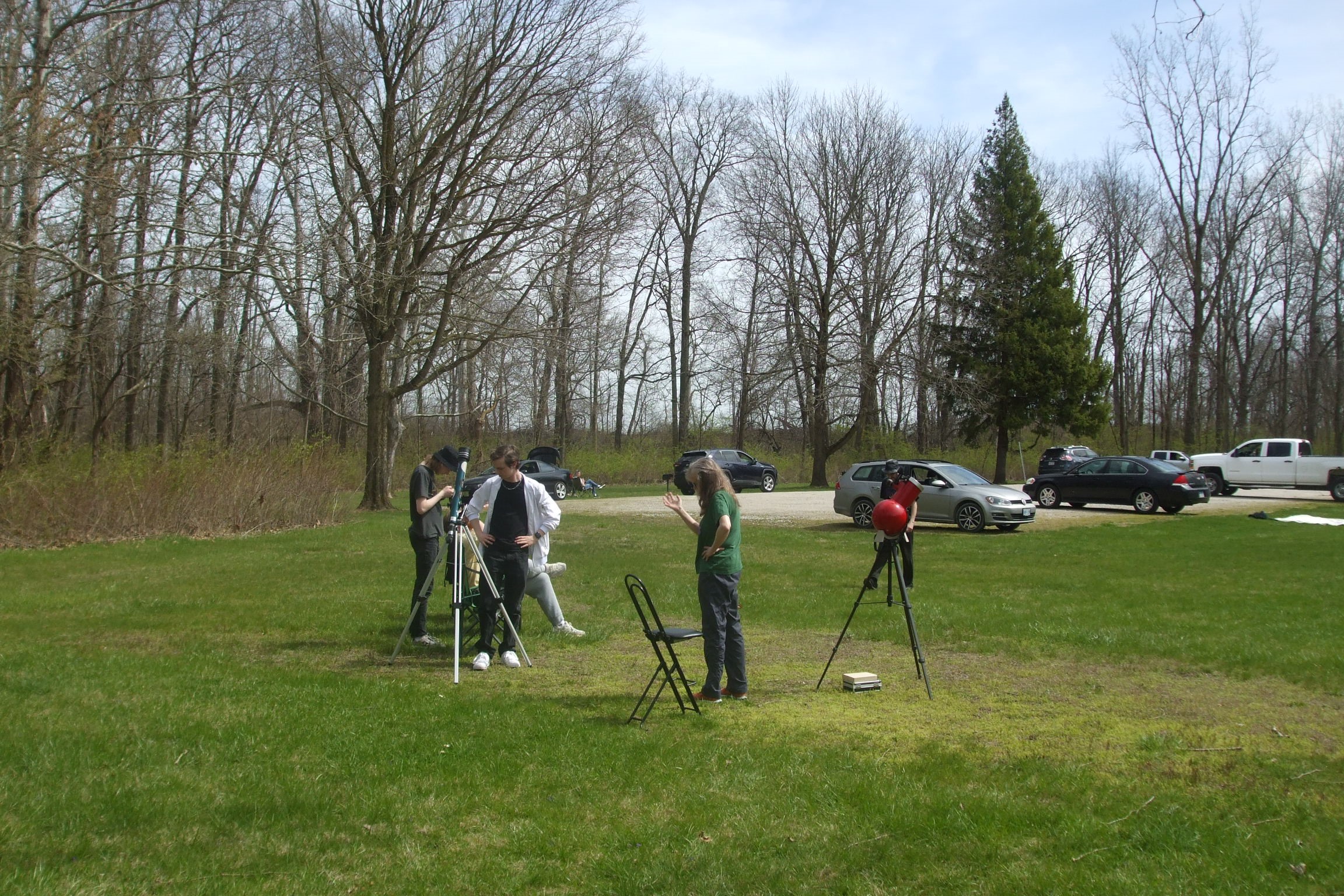
It was a very successful trip to Ohio to view totality.  We were able to experience 3' 40" of totality, an experience never to be forgotten. We braved horrendous traffic both ways, not getting home until 11:20 pm.  We left home at 9:15 am that morning.  We aimed for a small town (Tiffin), but on arrival it seemed to be nothing but a circus event, with preachers bellowing, people getting married, loud music blasting from a live band, and general overcrowding.  So we returned north 10 miles to Wolf Creek Park, and found our paradise location for this important day.  First some facts.  The park was a medium sized picnic grounds, with a large open grassy area.  We had a large picnic shelter for shade, but set up our Edmund Astroscan scope (4 1/4" mirror) in the open.  We have a solar filter that fits over it at the front.  Our latitude was 41 17' N, and the longitude was 83 10' west.  We used three eyepieces giving 16x, 18x, and 25x.

Our observing site at Wolf Creek Park, Ohio.  Deb checks out sunspots.  Our grey VW Golf in behind Deb.  The scope is an old but trusty Astroscan from Edmund Scientific.
 
Another view of the scope and our viewing area.  We brought a picnic lunch and snacks.
 
We were joined by some young viewing enthusiasts.  Hayden (white jacket) had travelled from North Carolina to view the eclipse.  He is a photographer and physics student at UNCG, mostly interested in astrophysics.

Skies were mainly sunny with high wispy clouds.  It became a bit hazier during totality.  The temperature at the start was 71 F.  It dropped to 63 F during totality.  There were three sunspot groups today.  We labelled a large double one "AA".  A smaller though still large one was called "B", while a smaller group of four tiny spots we called "C".  Eclipse start time was 13:56:30  Totality began at 15:11:16, and lasted for 3' 40".  Sunspot group "AA" was eclipsed at 14:38:43, taking 1' 50" to completely vanish.  A big group!  We did not stay long after totality was complete.

The experience of viewing a total eclipse was completely mind-boggling.  The plentiful birdsong from the woods ceased suddenly, the afternoon breeze vanished, darkness was nearly total, and  very sudden.  For 3' 40" we witnessed the bright corona shooting out in all directions from behind the moon, as well as a very large solar flare in the south end.  Special glasses are not needed during totality, and would only show darkness.  We saw a twilight sky on the southeast and northwest horizons.  Light bark on tall poplar trees stood out as if luminous under black light.  We could discern light and shadow on the ground right up to the final seconds.  Then, suddenly, darkness arrived, the most mysterious kind of dim twilight one could ever imagine.  The 'diamond ring' was visible in the telescope just before totality, lasting perhaps 1-2 seconds, accompanied by two 'beads' of light.  Others saw the ring with their special glasses.  Then came the spellbinding sight of the very active solar corona, accompanied by a sizable and bright flare at the south end.  There was darkness, stillness, and a  general quiet that became almost overwhelming.  All of this was seen and experienced with all normal senses.  The telescope showed nothing until the sun reemerged.  Venus and Jupiter shone brightly through the thin hazy clouds, Venus ahead of the sun and Jupiter behind it.  But even though we were near the centre, and enjoyed a fairly long eclipse time, it was over far too quickly.  It seemed as if one minute had passed, instead of almost four.

We were accompanied at our site by three young friends, who remained with us during most of the event, including totality.  They were happy to use the Astroscan, and we were happy that one of them, Hayden, was a photographer and physics student.  All of the shots of the sun on this page were taken by Hayden Atchison.  Through the telescope eyepiece he used his iPhone; for totality shots he used his main camera.  I took the daylight ground shots.

There is no doubt that the eclipse was also a hugely spiritual experience.  We have had many such experiences in our lifetime, but this one was greatly intensified because of its brevity.  Imagine taking the time to listen to all of the Mahler symphonies.  Now condense that experience down to 3 minutes and 40 seconds.  Imagine carefully studying all of the paintings by Pieter Bruegel the Elder, and condensing all those special moments of revelation and delight into 3' 40".  Our climb to the summit of Wheeler Peak in New Mexico took an entire day, but still energizes our spirits years later.  Again, condense that emotional, physical, and spiritual event into 3' 40".  Then you might have something of the effect (and affect) of viewing a total eclipse in the woodlands of Ohio.  It also gave us a tiny sense of just what the Sun actually is--a vast nuclear furnace of a scale that goes well beyond our comprehension.

This event happens to be my 999th logged astronomical event!  I began by studying the moon with binoculars in November 1968, and am still an active amateur astronomer.  It is also the last entry in my 13th volume of detailed notes recording my observations of the past 56 years.  A lucky volume, indeed.

Here are a few of Hayden's photos.

 
Shot through the eyepiece with an iPhone. The two largest sunspot groups show up well here.
 
The 'B' sunspot group is about to be eclipsed.

Approaching totality.  The sun's horns were actually very sharply focused in the telescope.
 
Many people saw a 99% eclipse only, including Toronto.  Even when only 1% of the sun is exposed, it throws the same amount of light as 400 full moons!  We could see shadows right up until totality.  While a 99% eclipse is very impressive in its own way, it is more than 99% less than viewing a total one.
 
A beautiful shot of totality by Hayden!  A jet trail comes between the eclipse and Venus.  The solar flare can be seen at the south end.  It was very prominent visually.
 
Totality 2024.  All images of the sun, above, were taken by Hayden Atchison, a physics student at UNCG.
 
If you were in the path of totality this year and managed to see the eclipse, drop me a line with your impressions.  I would love to hear about them.

Mapman Mike 

Tuesday, 27 February 2024

#148: NGC List Update

 It has been a long time since I actually counted my personally observed and logged NGC list.  When I acquired the 12" scope back in 2013 I decided to try and view as many of the list available to my location (42 N Lat.).  It turns out that more than half of the 7800+ objects are viewable from where I am.  Obviously I will not get through more than 4000 of them.  Will I?  To reach a reasonably dark sky I now have to drive 38 miles from home.  So nearly 80 miles round trip.  Readers can imagine how happy I am when I get out there only to find that the forecast doesn't pan out, and it is cloudy.  It happens, and is all part of the game.  Try to outwit the sky conditions, and predict when I might get some work done.  I consider 10 objects, including double stars, to be a minimally decent enough night, or 5 deep sky objects.  I always aspire to 20 or more, which makes the drive worthwhile.  Nearly two hours of driving to get in 3 hours of observing.  Though often I could stay longer, my eyes usually tire after 3 hours.

This February 2024 has been the warmest in my astronomy career.  I managed to get out four times and do some great deep sky and double star work.  When that last session was complete I finally tallied my object list.  I do not maintain a count of the hundreds and hundreds of double stars I have seen, but I do of deep sky objects.  Here is my life total to date:

NGC objects:  2779 (!!!).

IC objects:  416.

Objects from other catalogues:  817.

Total deep sky list:  4012.
 
All objects are indexed, and I can find any object in my notes quickly and easily.  The ones I have seen are also underlined in red in my Uranometria atlas.

And a major milestone is rapidly approaching.  To date I have logged 989 observing sessions!  With luck and clear skies, I will reach my 1000th observation session sometime this spring!  I plan on baking a cake for that occasion.  What will I do on my 1000th observation?  Carry on with the great work.

Mapman Mike

Wednesday, 31 January 2024

#147: Leo Deep Sky Part 8: Unranometria Chart #74, Left Side

 We are now examining the more northern reaches of Leo and its NGC objects.  Observations date from 2015-2016, using a 12" Dob.  Images are from Nasa.gov.

eg 2862:  2'.5 x 0'.3:  Vis.12.9; SB 13:  This galaxy was seen at 100x and viewed well as high as 200x.  It is an impressive and thin needle, with a stellar core.  A.v. shows a long, very thin slash, and it is quite bright.  187x and 200x were best, due to an 8.6 mag. star just S.  Recommended for thin galaxy fans!
eg 2862. 
 
eg 2893:  1.'1 x 1':  Vis./SB 13.2:  This galaxy took awhile to track down.  Once the correct nearby bright star was finally located, it showed up easily at 125x.  It sits SP a mag. 9.5 star, only 3' away.  The galaxy is round, pretty bright, and has a stellar core.  Good views were had up to 200x.
eg 2885:  1' x 0'.5:  Vis. 13.9; SB 12.4:  This faint galaxy was spotted at 125x and viewed up to 200x with a.v.  It appears round, so I was likely only seeing the central area. 
eg 2885 is at centre.  
 
eg 2896:  0'.9 x 0'.9:  Vis. 13.9; SB 13.5:  Picked off at 100x.  Viewed also at 125x and 150x, it was round, not small, and not difficult to view.  It resembles a faint, ghostly planetary nebula.
eg 2903:  12'.6 x 6':  Vis 9; SB 13.6:  Easily observed t 60x, it looks like a mini-Andromeda!  Superb views were had in all ranges up to 250x.  There is a very faint star F, and another one just S of the core, and yet another N of it.  The core area is very bright and stellar, surrounded by a slightly less bright region, then another layer, still bright but less so.  Finally the hazy envelope extensions on either end can be seen.  The galaxy is a very long, wide oval, all of it pretty bright in the 12" scope.  One of Leo's gems!
eg 2903. 
 
eg 2916:  2'.6 x 1'.9:  Vis. 12; SB 13.5:  Two decent galaxies in a row!  This one is pretty large, though only 1/4 the size of 2903.  It was pretty bright, including a middle area much brighter than the surrounding envelope.  Flaring resolution makes it difficult to see the true shape.  It does make a good comparison object with nearby 2903.  It is easy to sweep back and forth between them.
eg 2916.   
 
eg 2927:  1'.3 x 1':  Vis. 12.9; SB 13:  Viewed at 100x and 136x, it was oval, not hard to find,and pretty big.  No significant stars are nearby.  Though it had a bright centre, views were still best with a.v. 
eg 2929:  1'.2 x 0'.3:  Vis. 13.8; SB 12.5.  A triplet with eg 2930 and 2931 (see below).  29 was located at 136x, where it appears very elongated, and showing a bright centre.  At 187x and 200x all 3 galaxies are seen, stacked N to S.  30 is quite small, with 31 appearing notably larger and better with a.v.  Visually this is not a remarkable trio in a 12", though it's always fun to see 3 galaxies at a time.
eg 2930:  0'.7 x 0'.4:  Vis. 14.2; SB 12.7:  A trio with 2929 and 2931.  See above.
eg 2931:  0'. 8 x 0'.6:  Vis. 14.2; SB 13.2:  A trio with 2929 and 2930.  See above.
Centre to top:  eg 2929, 2930, and 2931. 
 
eg 2988:  0'.8 x 0'.3:  Vis. 14.6; SB 12.9:  A pair with 2991, below.  91 was easy to see at 136x, and shows a stellar core.  In this range it appeared oval and hazy.  At 187x, 200x, and 250x an elongated extension could be glimpsed with a.v., preceding the main galaxy.  The extension was very faint, though 91 remains bright.  This extension is 2988.
eg 2991:  1'.4 x 1'.1:  Vis.12.6; SB 13:  A pair with 2988, above.
eg 2991 is at centre; 2988 is nearly attached, just P.  
eg 2994 is at upper left. 
 
eg 2994:  1'.3 x 1'.1:  Vis. 13.1; SB 13.2:  Observed easily at 100x, 136x and 187x,the galaxy appears round and evenly bright.  Located between two pairs of stars F, it was best viewed using a.v.  Afterwards it could be seen even at 60x.  1991 and 1988 are SP.  See photo, above.
eg 3026:  2'.7 x 0'.8:  Vis. 12.9; SB 13.6:  I had hopes for this one; alas, mostly unfulfilled.  The galaxy was small, really faint, and though it was pretty large, it was not close to being 2'.7.  
eg 3026 is disappointing in a 12".  The specs indicated something better. 
 
eg 3032:  1'.7 x 1'.3:  Vis. 12.5' SB 13.2:  Located at 100x, it looks like a bright, fuzzy star.  It is located midway between 2 brighter stars, slightly F a line between them.  At 200x the galaxy shows a stellar core, being right and slightly oval overall.
eg 3032.  
 
eg 3068:  1'.1 x 0'.9:  Vis. 14.3; SB14.2:  I managed to find this one without aid of a diagram!  The conditions were splendid.  The galaxy was small, round, and at threshold with a.v. at 136x.  At 187x and 200x it was still visible.  Good luck with this one!
eg 3068.  
 
eg 3088A:  0'.5 x 0'.3:  Vis. 13.8;  SB 11.6:  A pair with 3088B.  See below.  Though an interacting pair of galaxies, only one ghostly object can be discerned.  No doubt I saw both, or part of both.  Perhaps a 16" can tell them apart.  It was a threshold object at 136x, 187x, 200x, 250x, and 375x.  There is a stellar core, but quite dim.  It is small and extremely faint.
eg 3088B:  0'.5 x 0'.5:  Vis. 15.4; SB 12:  A pair with 3088A, above and below.
eg 3088A is the brighter galaxy at centre; 3088B is elongated and SF.
They look like one object in my 12" mirror. 
 
eg 3098:  1'.4 x 0'.4:  Vis.?SB 12:  Located at 60x.  At 100x it appeared to be involved with a bright star, and was quite elongated though pretty small.  At 136x, 187x, and 200x there were 2 stars, or perhaps just one sitting near a bright stellar core. Overall it is a bright galaxy, and very elongated, though not large. 
eg 3098. 
 
Onward to Chart 73...
 
Mapman Mike


Monday, 29 January 2024

#146: Leo Deep Sky Part 7: Unranometria Chart #111, Right Side

 Only a small portion of Leo is on this chart.  In fact, only 4 galaxies will be discussed in this entry.  I use a 12" Dobsonian scope from Orion.  Observations here were carried out in 2018.

eg 3685:  0'.6 x 0'.3:  Vis. 14.1; SB 12.3:  A pinpoint map is required to locate this tiny faint oval smudge, conveniently located preceding 2 mag. 14 stars.  It was seen only with a.v., and then only intermittently, at 375x.  A real challenge for a 12" scope, but doable on a fine night.
eg 3685 is at centre. 
 
eg 3716:  0'.7 x 0'.6:  Vis.  13.5; SB 12.5:  Yet another hand drawn sketch helped me find this out of the way galaxy, which was seen at 84x, sitting between two brighter stars.  The galaxy is located mid-way between the stars, and just off-line (preceding).  At 136x it is faint, small, but quite easy to identify.  At 187x there are fairly good views using a.v.  The galaxy now appears slightly oval.  At 250x it is still small and somewhat ghostly in appearance, but distinct from the background sky. 
eg 3716. 
 
eg 3719:  1'.8 x 1'.3:  Vis. 13; SB 13.8:  A pair with eg 3720, below.  Both galaxies were seen at 84x.  At 136x they were cleaner, brighter, and larger.  19 is much larger and fainter, making 20 easier to see.  At 187x 20 pops right out at the viewer, while 19 takes a bit longer to come forth.  The latter is now big and oval.  At 250x both galaxies are sowing bright cores, but 19 is beginning to fade.  Still, they make a fun pair in a 12" mirror.
eg 3720:  1' x 0'.9:  Vis. 13; SB 12.7:  A pair with 3719.  See above.
3719 is the larger galaxy near centre, followed by 3720. 
 
This completes the lower and middle charts of Leo on Uranometria.  Next we turn north, beginning on Chart 74....
 
Mapman Mike


Tuesday, 23 January 2024

#145: Leo Deep Sky Part 6: Unranometria Chart #112, Left Side

 Charts 111 and 112 are effectively the only low Leo charts, as nothing I observed appears on Chart 132 and 131 that does not appear here.
 
eg 3434:  2'.1 x 1'.9:  Vis. 12.8; SB 12.4:  Viewed initially at 60x and 120x, the galaxy was round and had a bright centre.  At 136x a very faint star is immediately N.  A mag. 8.5 star is always in view.  272x shows a stellar core, then a larger bright central area, and finally the fainter surrounding envelope.
eg 3434.  
 
eg 3495: 3'.8 x 1':  Vis. 11.8; SB 13.6:  Located at 60x.  At 100x and up to 136x, views of this remarkable object are hampered a very bright star, 58, and mag. 5.5.  The galaxy is very elongated with a bright oval centre.  At 187x and 250x, with star 58 out of view, I saw a very fine edge-on galaxy, especially with a.v.  Nice!
eg 3495. 
 
eg 3509:  2'.1 x 1':  Vis. 12.7; SB 13.4:  The galaxy is visible at 100x, but is not large.  136x shows it as oval, using a.v.  187x gives the best view.  The oval is now pretty large, with a wide middle.  A very faint star is F (?).  At 200x the galaxy begins to fade.  In photos this is a highly irregular galaxy, and I wouldn't mind another look with my upgraded eyepieces.
eg 3509. 
 
eg 3521:  11'.2 x 5'.5:  Vis. 9; SB 13.3:  Shockingly bright at 60x, it is also very large.  I enjoyed excellent views up to 250x.  The galaxy appears as a very elongated oval, with a stellar core.  There is a large, very bright middle, and then a bright envelope, gradually fading to the edges.  This is one of the brightest galaxies in Leo, viewable in virtually all apertures.  Worth many return visits. 
eg 3521. 
 
eg 3535:  1'.7 x 0'.8:  Vis.  13.5; SB 13.7:  Observed at 136x and 187x, this very faint oval was viewed best with a.v.  A faint star is following.
eg 3535. 
 
eg 3567:  0'.9 x 0'.7:  Vis. 13.3; SB 12.76:  Observed at 187x, the galaxy is bright but quite small.  It was located within a triangle of 3 brighter stars, almost centre.
eg 3580:  0'.9 x 0'.3:  Vis. 14; SB 12.9:  Located at 136x, using a hand-drawn detailed map.  It was oval, bright, and small.  At 187x and 250x it is quite bright.  A mag. 12 (?) star is following.  The galaxy is cigar shaped, and an easy object to see, but it is small. 
 
eg 3580. 
 
eg 3601:  0'.5 x 0'.5:  Vis. 13.8; SB 12.1:  Located at 136x, it looked like a fuzzy star.  It was bright and actually a pretty good size at 187x and 250x.  It proved to be an easy object for a 12" scope on a fine night.
eg 3611:  2' x 1'.6:  Vis. 12.2; SB 13.3:  Located at 60x and viewed up to 250x.  At low to mid power it appeared round and very bright.  At 250x it was now oval, and quite large with a.v.  It shows a bright stellar core, a very bright middle section, and a fainter envelope.
eg 3611. 
 
eg 3630:  2'.1 x 0'.9:  Vis. 12; SB 12.6:  Located at 100x , it appears as if a bright star overlays the galaxy.  At 136s the centre is very, very bright, and still seems as if it is actually a star (it isn't!). 187x gives decent views of a nice object,especially when occasional glimpses of its full length are obtained using a.v.  250x also provides a fine view.
eg 3630.  
 
eg 3633:  1'.1 x 0'.4:  Vis. 13.5; SB 12.5:  At 100x a pretty small suspicious oval patch was seen.  At 136x the galaxy is now obvious, though small and pretty faint.  the object was decent at view at 187x when a.v. was used.  It is very elongated.  Good views were also obtained using 250x and a.v.
eg 3633. 
 
eg 3640:  4' x 3'.2:  Vis. 10.4; SB 13.2:  A pair with 3641.  Located at 85x, 40 is very large, very bright, and slightly oval.  I stopped down to 8" of aperture and enjoyed a fine view as well.  At 12" and 85x 3641 was glimpsed.  At 136x the galaxy becomes very very large, showing a big and bright centre, and a fainter but still pretty bright envelope.  3641 could be seen in this range using 8", but it was considerably smaller than viewed at 12".  At 187x and 12", 41 shows a brighter centre with fainter outer haze.  It is round, and there is notable separation from 3640.  At 250x and 375x both galaxies remain bright.  I noted a possible variation in brightness in some areas of 40's outer envelope.  A real showpiece!
eg 3641:  0'.9 x 0'.9:  Vis. 13.2; SB 13.  A pair with 3640.  See above.
eg 3640 (centre) and 3641, south of it. 
 
eg 3643:  1'.2 x 0'.8:  Vis. 14; SB 13.9:  At 187x this galaxy is small and faint, but quite oval.  There is a faint star SF.  Views are slightly better at 250x.
eg 3644:  1'.5 x 0'.7:  Vis. 13.7; SB 13.6:  I had a lot of difficulty finding this galaxy.  I finally glimpsed it like a small shadow just N of a faint star, itself N of other stars of note.  Seen at 187x, 200x, and 250x with a.v. only.  It is very small, oval, very faint, and even the dim star S of it dampens its appearance.  It was a painful way to end an otherwise productive and fun night of observing.
eg 3645:  0'.6 x 0'.6:  Vis.  14.3; SB 13.5:  There is some controversy here, with many sources claiming that this is the same object as eg 3630.  Unranometria instead plots this extremely faint, small, round object as the one and only.  Viewed with a.v. at 200x and 250x, it forms the apex of a triangle with two stars F, one N and one F.
3645 is at centre.  Note the triangle with two stars, one N and one F. 
 
eg 3647:  0'.3 x 0'.3:  Vis. 14.6; SB 12.1:  The sighting of this tiny faint galaxy at 200x and 250x completes a group of 7 that include 3630, 3640, 3641, 3643, 3644, and 3645!  This night I was able to review the other six quite easily, though 43, 44, and 45 are also very tricky.  47 is small, faint, hazy, and F a somewhat brighter star.  This star may, in fact, be another galaxy.
eg 3664:  2'.1 x 1'.9:  Vis. 12.8; SB 14:  A pair with 3666A.  64 is faint and elusive at 84x, but somewhat better at 136x.  It is very elongated at this power.  It then seems to become more round at 187x and 250x.  While not difficult to see, it is quite faint.  It is pretty large, with one area being brighter (the oval shape at 136x?).  3664A was first confirmed at 375x, being very faint and possibly round, but "broken" on one side.
eg 3664A:  1'.1 x 1':  Vis. 14.3; SB 14.2:  A pair with eg 3664.  See above.
eg 3664 is at centre, with 64A S.  C39-173 is in the 
lower right corner, not observed. 
 
eg 3662:  1'.3 x 0'.8:  Vis. 12.9; SB 13:  Located at 84x.  At 136x a stellar core is noted, and the galaxy becomes elongated.  It seems pretty small, but it is fairly bright.  At 187x and 250x I had good views.  It is now a good size, with a very bright centre.  A faint star is S.
eg 3679: 1' x 0'.8:  Vis. 14.2; SB 13.3:  Located at 187x, this one required a hand-drawn pinpoint map to locate.  With this tool it is not a difficult object to see.  A faint star is N.  At 250x things are considerably better.  It seems quite oval, and though ghostly it can be seen well.
eg 3679. 
 
Mapman Mike